Whether it's natural disasters, IT outages, pandemics, or geopolitical crises, the number of potential threats to companies' ability to operate is constantly increasing. At the same time, regulatory requirements and customer expectations for stable service provision are increasing. This is exactly where a professional business continuity management system (BCMS) comes in.
BCM aims to ensure business continuity and to be able to continue critical processes even in exceptional situations or restore them as quickly as possible. Companies that systematically ensure their business continuity not only reduce risks, but also increase their competitiveness and resilience.
A BCMS is much more than just an emergency plan in a drawer. It is a living part of strategic management and must be constantly reviewed, tested and adapted. This is where Aeneis comes in.
What is a BCMS? Definition and distinction
A business continuity management system (BCMS) is a holistic management system with documented processes, responsibilities, and procedures that enables companies to prepare and respond effectively to serious disruptions such as IT failures, natural disasters, cyber attacks, or supply chain disruptions. The aim of a BCMS is to maintain or restore the operational capacity of the organization within acceptable periods of time, thus minimizing reputational, financial and compliance damage. It creates the basis for robust governance that ensures the continuity of business operations even in crisis situations.
Key terms in BCMS:
- Business Impact Analysis (BIA): Analysis of the effects of process failures on the company.
- BCP (Business Continuity Plan): Documented plan with emergency strategies, processes and contacts.
- Recovery Time Objective (RTO): Time in which a process must be recovered after failure.
- Recovery Point Objective (RPO): Maximum tolerated data loss, measured in time (e.g. last backup).
- MTD (Maximum Tolerable Downtime): Maximum tolerable downtime of a process.
- Recovery Strategy: Procedure to restore functionality.
A BCMS is closely integrated with risk management, emergency management, and IT emergency planning, but differs in that it takes a holistic, process-oriented approach.
Regulatory requirements and standards
Statutory and normative requirements for business continuity are increasing. The most important regulations include:
- ISO 22301: International standard for business continuity management systems. It defines requirements for building, implementing, operating and continuously improving a documented BCMS. ISO 22301 provides the globally recognized framework for a resilient company and focuses on the effectiveness of the BCM.
- BSI-KritisV: Regulation for the determination of critical infrastructures (KRITIS) under the BSI Act. It requires operators from sectors such as energy, health or water to take appropriate organizational and technical measures for reliability and IT security. An effective BCMS is a key requirement.
- DORA (Digital Operational Resilience Act): This EU regulation obliges financial service providers to ensure their digital operational stability. DORA explicitly requires robust BCM and emergency concepts in order to remain able to act in the event of cyber attacks, system failures or third-party disruptions.
- NIS-2 (Network and Information Security Directive): The revised EU Directive obliges a significantly wider group of companies — including many SMEs from sectors related to KRITIS — to introduce robust security and resilience measures. This expressly includes business continuity measures. NIS-2 requires, among other things, the implementation and ongoing maintenance of emergency plans, clear responsibilities and the regular review of the effectiveness of existing BCM strategies. With Aeneis, these requirements can be holistically documented and systematically met as part of an integrated GRC approach.
- MaRisk AT 7.3: BaFin's minimum risk management requirements (MaRisk) require the implementation of an emergency concept in AT 7.3. In particular, this must ensure the continuity of critical processes and be tested regularly, which makes a functioning BCMS a prerequisite.
Aeneis provides support for implementation:
The GRC software Aeneis integrates a BCMS module that is specifically tailored to the requirements of legal and normative requirements. The software thus enables the central, audit-proof and standard-compliant implementation of all necessary measures.
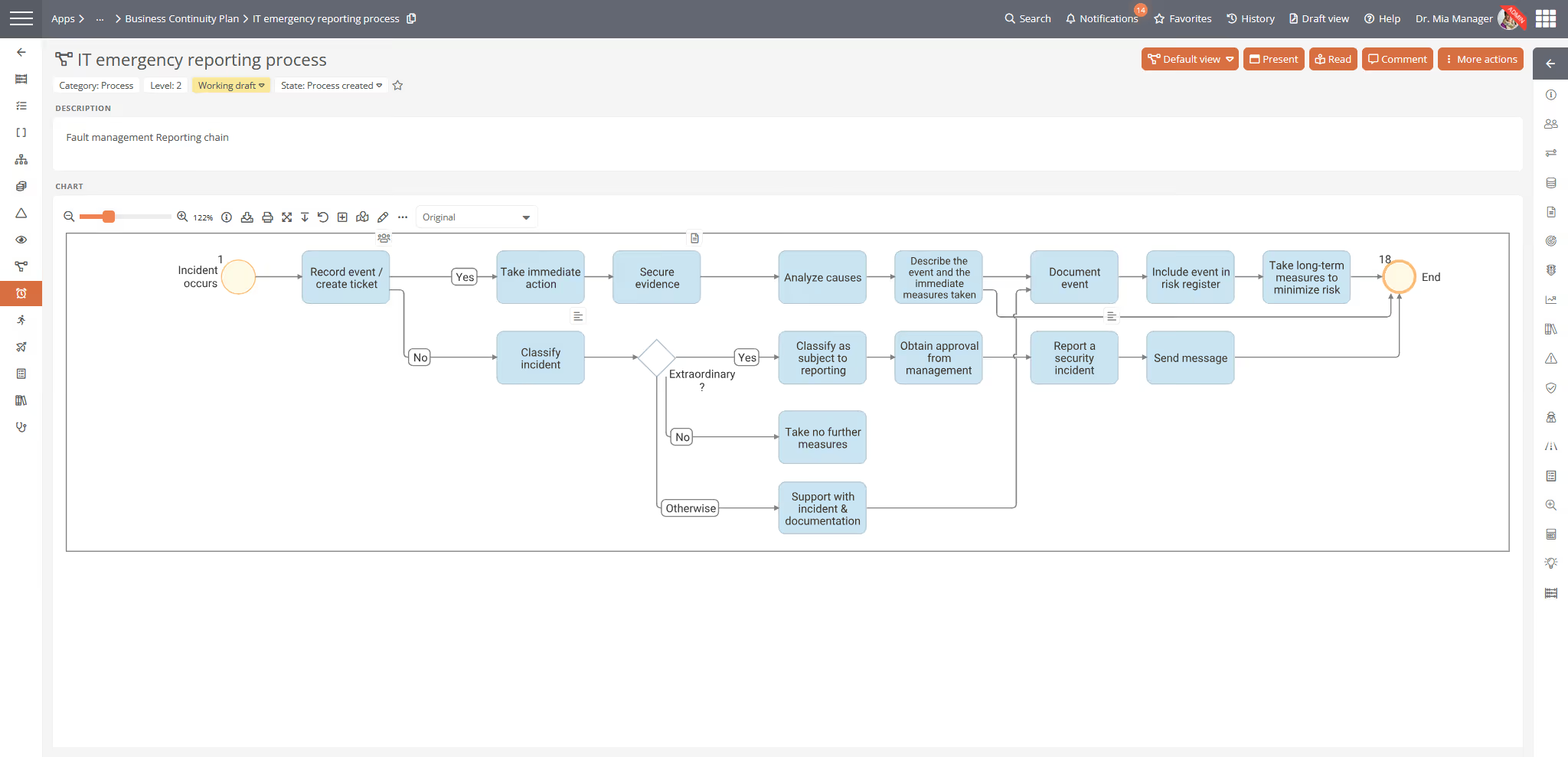
Companies can model their business continuity processes directly in Aeneis, link risks, document recovery times and maintain relevant documents. The standards chapters from ISO 22301 and related standards can be mapped in a structured way in the system and can be networked with roles, processes and IT systems. In this way, business continuity is not only planned, but also operationally and strategically anchored in the company.
The BCM lifecycle in detail <--
A professional BCMS follows a structured lifecycle. Aeneis represents all phases of this cycle on the software side and supports their implementation:

1. Initialization and project planning
- Defining goals, roles, and responsibilities
- Project setup directly in the Aeneis portal with areas of application and workflows
2. Business Impact Analysis (BIA)
- Identification of critical processes, resources, dependencies
- Assessment of effects (e.g. financial losses, image damage)
- Set RTO, MTD, link with risks and IT systems
3. Risk assessment & strategy development
- Assessment of risks such as blackout, cyber attack or pandemic
- Definition of recovery strategies: workaround, outsourcing, cloud usage, etc.
4. Planning and implementation
- Preparation of recovery, emergency, and communication plans
- Assignment of responsible persons, resource management, documentation
5. Practice, Testing, and Optimization
- Schedule regular tests and emergency drills
- Evaluation of test results in the Aeneis dashboard
- Continuous improvement through lessons learned and change management
Digital support in an emergency: Aeneis as an operational platform
In crisis situations, every second and every piece of information counts. Aeneis offers a digital platform that enables companies to both plan and react quickly in critical moments. The BCMS app creates transparency about which processes, resources and systems are decisive for the continued existence of the company.
In concrete terms, this means:
- Central availability of recovery plans: All information is accessible and stored in a structured manner based on roles.
- Linking to dependencies: Processes are linked to IT systems, locations and contacts. In this way, those responsible can see at a glance which components are affected.
- Dashboard-based overview: Using traffic light logic, BCM coordinators recognize whether recovery goals have been achieved or exceeded.
- Traceability for audits and lessons learned: Every planning and decision in the BCM is documented and can be systematically evaluated.

Aeneis thus creates the indispensable basis on which all these systems function in an emergency: clarity about what is important, who is responsible, and what needs to be done. For a digital resilience organization.
Integration with other management systems
In Aeneis, all apps are based on a common database. This means that information, once documented and evaluated, is directly available in all GRC apps and in the BPM model without redundancies or media breaks.
This provides specific benefits for BCMS:
- ISMS & BCMS work hand in hand: Ratings made in Information Security Management can be reused in BCMS.
- No double data maintenance: Roles, processes, IT components and locations do not have to be entered multiple times; changes have a system-wide effect.
- Integrated ICS: Controls can be recorded, assessed and monitored in the SoA (Statement of Applicability).
- Complete traceability: All relationships between processes, risks, systems and people are visually representable and logically comprehensible.
This makes Aeneis the ideal platform for companies that want to set up an Integrated Management System (IMS) or consolidate their existing system. BCM is not a separate component here, but part of a consistently networked GRC strategy.
Aeneis BCMS: Resilience at the push of a button
With the BCMS module in Aeneis, companies are able to holistically set up effective business continuity management, fully integrated into their governance, risk and compliance system.
What makes the Aeneis BCMS module stand out?
- Centralized maintenance of critical processes: Business processes can be identified and evaluated directly in the Aeneis portal and provided with recovery plans and maximum tolerable downtime (MTD), for example.
- Illustration of effects: Aeneis supports Business Impact Analysis (BIA) to make the effects of an outage on organizational units, systems and customers transparent.
- Linking with risks and IT systems: Criticality assessments are based on linked data from ISMS, IT documentation and process landscapes.
- Role-specific dashboard: Responsible persons, emergency officers, BCM coordinators and top management receive tailor-made views of KPIs, tasks, conditions and restart times.
- Emergency and recovery plans at the push of a button: Aeneis generates complete, structured reports for audits, exercises, emergencies or external audits.
- Release process: Versioning, responsibilities and documentation are organized in an audit-proof manner via system-integrated workflows.
- Live monitoring of restart processes: Thanks to integrated task management, planned measures can be initiated and monitored directly.
Strategic relevance of BCMS for companies
A robust BCMS is a must today — particularly for regulated industries.
The benefits at a glance:
- Legal certainty: Evidence to supervisory authorities (e.g. BaFin, BNetzA, LfDI)
- Market advantage: Trust among customers and suppliers through documented continuity planning
- Risk reduction: Systematic avoidance of follow-up costs in the event of failures
- Increasing efficiency: Uniform documentation saves effort and reduces media breaks
- Securing knowledge: All processes, roles and dependencies are centrally documented and can be versioned
A structured approach is crucial, especially when it comes to complex supply chains or heavily IT-based services. Aeneis provides support at every stage of the BCM lifecycle.
Industry solutions: BCM with Aeneis in practice
For financial service providers:
- Implementation of the 7th MaRisk Amendment
- Linking BCM with documented governance framework
- Integration with risk management system
For energy suppliers:
- Securing critical processes in accordance with BSI KritisV
- Documentation and verifiability vis-à-vis the Federal Network Agency (BNetzA)
For mechanical and plant engineering:
- Protection against production downtime
- Coordinating global supply chains
- Digital recovery concepts after cyber attacks
For hospitals and care facilities:
- Ensuring patient care in an emergency
- Planning alternative processes and emergency teams
Conclusion: Making business continuity future-proof with Aeneis
Business continuity management is no longer a nice-to-have. Companies that rely on resilience not only secure their own future, but also the trust of their customers, partners and regulatory authorities.
With the BCMS in Aeneis, intellior offers a practical, integrated and user-friendly solution — for all industries that want to professionally ensure continuity, meet regulatory requirements and establish effective governance. See BCMS in action in Aeneis within a live demo!

FAQ
What is a Business Continuity Management System (BCMS)?
A BCMS ensures that critical processes can be continued or quickly restored even in crises such as IT outages, natural disasters or cyber attacks. With Aeneis, these processes are documented, responsibilities are defined and recovery plans are managed in an audit-proof manner.
What regulatory requirements does a BCMS with Aeneis meet?
Aeneis supports compliance with central requirements such as ISO 22301, BSI-KritisV, DORA, NIS-2 or MaRisk AT 7.3. The standards chapters can be mapped directly in the system, linked to processes, roles and IT systems and documented in an audit-proof manner.
How does Aeneis support the BCM lifecycle?
From business impact analysis (BIA) to risk assessment to emergency plans and tests, Aeneis digitally maps all phases of the BCM lifecycle. Dashboards and workflows ensure transparency, traceability and continuous optimization.
What advantages does Aeneis offer as a digital platform in an emergency?
In crisis situations, Aeneis provides all recovery plans, responsibilities and dependencies centrally. Responsible persons can see at a glance which systems or processes are affected and can directly control and document measures.
How does Aeneis integrate with other management systems?
Aeneis works seamlessly with ISMS, ICS and risk management. Once recorded, information such as roles, IT components or risks is used across the system, avoiding redundancies and increasing efficiency.
For which industries is BCM with Aeneis particularly relevant?
Aeneis is used in regulated industries such as financial services, energy supply, mechanical engineering or healthcare. There, the BCMS module helps companies meet legal requirements and at the same time strengthen resilience and competitiveness.
What are the overall benefits of a BCMS with Aeneis for companies?
Companies benefit from legal certainty, higher efficiency, reduced risks and a central knowledge store. With Aeneis, business continuity becomes an integrated part of governance, risk and compliance management.