Regulatory pressure and digital responsibility
Mechanical engineering companies are caught between digitalization, global supply chains and the growing threat of cyber attacks. The EU Cyber Resilience Act (CRA) intensifies this pressure: Manufacturers and operators of connected products are required to systematically identify, assess and address IT security risks throughout the entire life cycle.
In mechanical and plant engineering in particular — with its complex, often durable products and diverse digital interfaces — the CRA represents a paradigm shift. The key to successful implementation? A robust, integrated risk management system that is not only legally compliant, but also efficient and comprehensible.
With the Aeneis BPM and GRC software, these requirements can be implemented in a practical and future-proof manner.
Mastering CRA requirements in a targeted manner — with Aeneis
What is the Cyber Resilience Act (CRA)?
The Cyber Resilience Act (CRA) is a European Union regulation that aims to ensure the cybersecurity of connected products over their entire life cycle. It is part of the EU cybersecurity legal framework and aims to strengthen Europe's single market and better protect consumers and companies from digital risks.
Status and schedule:
- Proposed: The CRA was proposed by the EU Commission in September 2022.
- Adopted: The CRA was adopted by the European Parliament and the Council of the EU on October 23, 2024.
- Entry into force: The regulation came into force on December 10, 2024.
- Reporting requirement: Vulnerabilities and security incidents must be reported from September 11, 2026.
- Application: The CRA's main obligations apply as of December 11, 2027.
Why is the CRA necessary? With the CRA, the EU is responding to the increasing security gaps in connected products. Existing regulations such as CE marking or product liability do not sufficiently cover cybersecurity aspects. For the first time, the CRA therefore obliges manufacturers to actively manage security risks, provide security updates and create transparency about vulnerabilities and protective measures.
The aim is to create a uniform, high security standard for all digital products with a direct or indirect connection to the Internet, from industrial sensors and smart home devices to machine controls in production environments.
What the Cyber Resilience Act requires
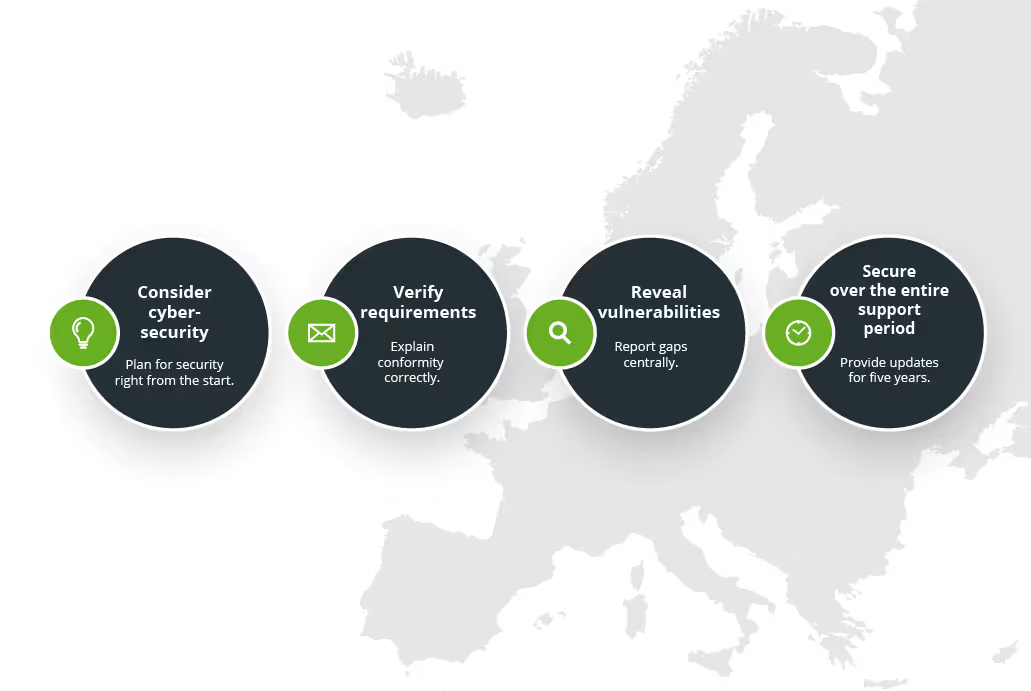
The CRA requires manufacturers to:
- Implement security by design and safety by default as early as the product development stage
- Provide complete documentation of all risks and measures
- Conduct risk assessments and vulnerability management across the entire product lifecycle
- Respond immediately to any security vulnerabilities that are discovered, including reporting
Mechanical engineering products such as machine tools, robotic systems or control units are increasingly connected. They form the backbone of industrial infrastructures, often in critical areas. A security incident here can not only endanger production downtimes but also human lives. The requirements and liability risk are correspondingly high.
Which mechanical engineering products are specifically affected by CRA?
The Cyber Resilience Act applies to all products with digital elements that can be connected directly or indirectly to a network. For mechanical engineering companies, this is a far-reaching requirement, as many modern machines and components are now part of a networked production environment.
Among others, the following are affected:
- Industrial PCs and control units, for example with a Windows or Linux operating system
- PLC systems (programmable logic controllers) in manufacturing plants
- Machines with web interfaces or remote maintenance interfaces
- Sensors and actuators that communicate via field buses or industrial Ethernet protocols
- Embedded software in robots, CNC systems or multi-axis controls
- External tools or cloud services that are used for maintenance, diagnosis, or update processes
Particularly critical: Software components from third-party providers are also subject to CRA regulation. This brings the entire machine IT ecosystem into focus, including the supply chain.
With Aeneis, mechanical engineers can make this complex network manageable: Product architectures, IT components, dependencies, suppliers, processes and responsibilities can be transparently modeled, analyzed and tested for risk potential.
Supply chain security and third-party providers: A new responsibility
The CRA clarifies: Manufacturers remain responsible for the safety of the entire product, even if parts of it come from external partners or suppliers. This applies in particular to:
- Purchased software libraries and firmware
- IT components with their own network function
- Cloud-based maintenance services or digital twins
The EU therefore requires manufacturers to maintain a so-called Software Bill of Materials (SBOM), i.e. a detailed list of all digital components of a product, including origin, version and potential vulnerabilities.
With Aeneis, this requirement can be implemented in an elegant way:
- Supplier risks are recorded and assessed centrally
- SBOMs can be documented in a structured way and linked to processes
- Obligations and audit obligations arising from contracts can be identified as sources of risk
- Automatic reports ensure transparency for auditors and authorities
Especially in mechanical engineering, where many companies work with long-standing supplier networks and specialized OEM partners, Aeneis thus creates a reliable basis for compliance and trust without operational overload.
Aeneis as a hub for your risk management
Aeneis enables engineering companies to build an integrated risk management system that meets all CRA requirements and also:
- Centrally manage risk inventory: Processes, systems, products and suppliers are clearly modeled and linked to risks.
- Systematically assess risks: The risk analysis is structured in accordance with ISO 31000 with configurable assessment criteria.
- Track and document measures: From vulnerability handling to technical measures to communication with customers, everything remains traceable and audit-proof.
- Manage obligations: By integrating standards and laws such as CRA, NIS-2 or ISO standards, you keep an eye on all legal requirements.
- Act immediately in the event of a crisis: In combination with the BCMS app, the emergency plan is also just a click away.
More about risk management in Aeneis
Digital, comprehensible, secure — the benefits of Aeneis
The Aeneis BPM and GRC software offers mechanical engineering companies more than just a tool for documentation. It becomes a platform for strategic cyber risk management:
- End-to-end visibility: Risks are not considered in isolation, but are linked directly to business processes, responsible persons and systems.
- Process maps for risk transparency: The intuitive visualization creates clarity, even for management and external auditors.
- Current risk status at a glance: Criticality, progress of measures and responsibilities are always visible in Aeneis for consistently transparent and action-oriented risk management.
- Modularly expandable: Data protection, information security, BCM — everything can be seamlessly mapped in a central system.
From mandatory topic to management task: How the CRA is changing risk management in mechanical engineering
The CRA forces mechanical engineering companies to bring the issue of IT and product security out of a purely technical or compliance corner. It is not just about meeting minimum regulatory requirements, but also about strategically securing the business model in an increasingly connected industry.
Because: With CRA, cybersecurity is becoming a core business task, comparable to quality or product safety.
What does that mean in practice:
- C-level relevance: Risk management becomes a top priority. The liability risks are real and affect management and board of directors.
- Interdisciplinary collaboration: IT, engineering, legal, QM and purchasing must work together systematically, ideally via a central platform such as Aeneis.
- Change in corporate culture: Safety awareness must be anchored not only in products, but also in processes, training and management culture.
- Process orientation: Effective risk management requires a consistent process basis. Aeneis provides this basis and enables the seamless integration of other management systems such as ISMS, audit management or BCM.
Particularly interesting: Companies that see the CRA not only as a regulatory hurdle but as an opportunity for greater resilience and customer benefits create trust with partners, customers and investors.
Example: Risk analysis in the lifecycle of a robot
A mechanical engineering company that develops and produces industrial robots uses Aeneis to systematically manage risks across the entire product lifecycle, from development to maintenance:
- In development: Potential risks associated with the software used are identified and recorded in the system as process risks. These are linked directly to the affected development processes.
- In production: The company assesses risks such as the ability to manipulate control units or physical hazards due to improper assembly. Appropriate controls are stored for each risk, e.g. checks before delivery.
- At the customer's premises: Relevant corporate risks such as misuse of remote maintenance interfaces or unauthorized access are analyzed and provided with appropriate control tasks — such as regular access controls.
- In service: Risk scenarios are defined for known weak points or potential failures. Aeneis makes it possible to create measures to minimize risks, assign those responsible and monitor their implementation — such as the regular replacement of safety-critical components.
The result:
All risks are documented in a structured manner, linked to processes and responsibilities, and secured through regular monitoring and review tasks. In this way, the CRA is not only met, but the company also gains internal transparency and security of action
CRA as an opportunity for greater resilience — with Aeneis as a partner
The Cyber Resilience Act is more than just a compliance issue, it is a wake-up call. Anyone who takes it seriously not only protects their products and customers, but also secures a competitive advantage.
With Aeneis, we offer a sophisticated, practical software solution with which mechanical engineering companies can professionally implement regulatory requirements, manage risks transparently and sustainably strengthen their cyber resilience.
Let one of our experts show you the risk management system in Aeneis! Book your live demo now!

FAQ
What is the Cyber Resilience Act (CRA)?
The CRA is an EU regulation that requires manufacturers and operators of connected products to systematically identify, assess and address cyber risks over the entire lifecycle. With Aeneis, mechanical engineering companies can fulfill these obligations efficiently and in an audit-proof manner.
Why is the CRA particularly affecting mechanical engineering?
Mechanical engineering products such as control systems, robots or networked machines are increasingly digital components of industrial infrastructures. With Aeneis, their architectures, interfaces and dependencies can be transparently documented and risks can be linked directly to processes and responsibilities.
Which mechanical engineering products fall under the CRA?
All products with digital elements that are connected to a network, such as PLCs, industrial PCs, sensors, embedded software or remote maintenance tools. Aeneis makes it possible to record these systems and their risks in a structured manner and to verify them in an audit-proof manner.
How does Aeneis help manage supply chain and third-party risks?
The CRA also requires manufacturers to document the risks of external software and hardware components. Aeneis makes these risks transparent, enables structured documentation of all components used and links them to processes, contracts and audit obligations. In this way, machine manufacturers also keep complex supplier networks under control.
What features does Aeneis provide for CRA-compliant risk management?
With Aeneis, risks can be assessed in accordance with ISO 31000, measures can be documented and the status can be monitored at any time. Automated reports ensure transparency, while process maps visualize connections between products, systems and risks.
Why does the CRA make risk management a top priority?
The CRA enshrines cybersecurity as a management responsibility with clear liability risks. Aeneis provides support by presenting risks, responsibilities and measures centrally and thus creating a verifiable governance structure.
What opportunities does the CRA offer for engineering companies with Aeneis?
Companies that implement the CRA with Aeneis not only fulfill regulatory obligations, but also create trust with customers and partners. With Aeneis, companies are strengthening their cyber resilience, reducing liability risks and opening up competitive advantages through greater transparency and security.