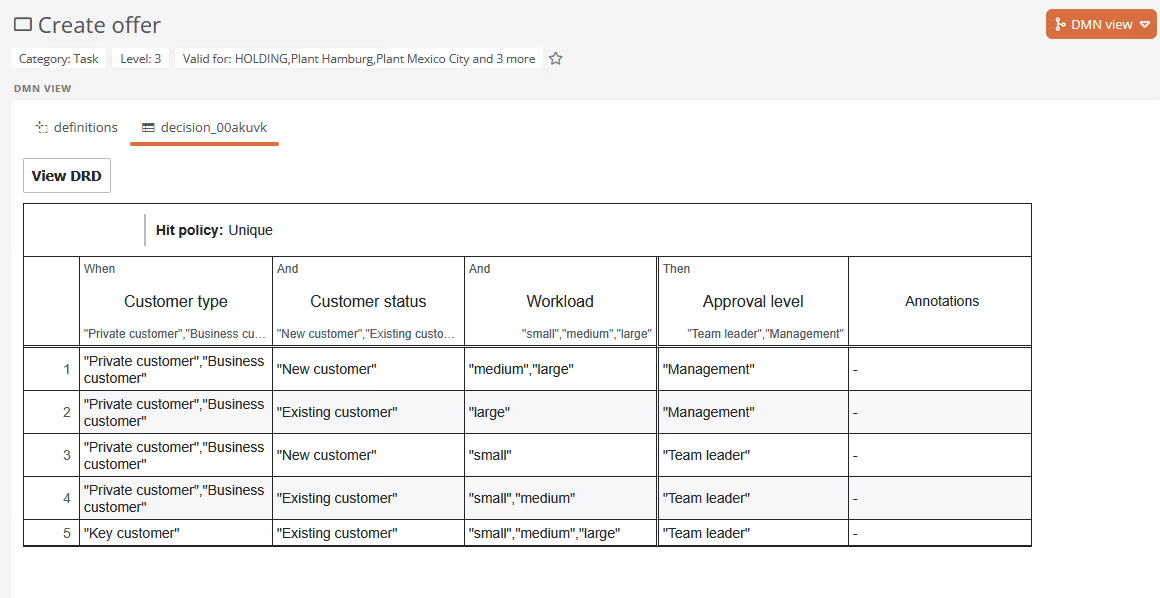
Decision Model and Notation (DMN) is an international standard of OMG (Object Management Group) to model decisions in a clear, structured and comprehensible way. DMN describes which inputs and criteria in an organization lead to a specific decision and how this decision logic is structured.
The focus is on the decision table, in which rules are clearly formulated: Which combination of conditions leads to which result. As a result, decision-making processes that are otherwise often hidden in text documents, experiential knowledge or unclear formulations become visible and reproducible.
DMN is particularly suitable for situations in which decisions occur regularly, are affected by regulatory requirements or have to be made uniformly across locations. The method promotes transparency, reduces scope for interpretation and creates a basis for automated decisions in processes.
In the Aeneis BPM suite, DMN can be used for so-called rule tasks to model decision logics directly in the portal. This makes DMN an important component in the interplay of process management, governance and compliance.
How do BPMN and DMN differ and what do they both have in common?
Differences between BPMN and DMN
Focus: BPMN describes processes, i.e. how a process works step by step. DMN models the decision rules that are applied within a process.
Presentation: BPMN presents activities, roles, events, and gateways, while DMN works with decision tables and decision requirements diagrams.
Question: BPMN answers the question of how a process is executed. DMN answers why a particular decision is made this way.
Area of use: BPMN is used primarily for process design, DMN for standardization and transparency of rules and evaluation criteria.
Similarities between BPMN and DMN
Both are Object Management Group standards and are recognized worldwide.
Both make corporate logic understandable and comprehensible in a structured way.
Both support automation: BPMN at process level, DMN at decision level.
In Aeneis, both complement each other ideally because processes and decision models together result in a complete, process-oriented management system.
How is DMN specifically supported in Aeneis?
In Aeneis, the DMN (Decision Model and Notation) diagram type is available to clearly and comprehensibly represent decision logics within processes. DMN can be used there in rule tasks, i.e. in activities where not only the process is decisive, but a binding decision must be made.
This is how it works in practice:
Identification: The process model identifies the tasks for which decision logic should be standardized, such as risk classifications, release decisions or escalation rules.
Modeling: In the DMN view, a decision table is created that defines input criteria (e.g. risk level, probability of occurrence) and the possible results (e.g. action required, accept risk). In parallel, a Decision Requirements Diagram (DRD) can be modeled, which shows how several decisions depend on each other.
Integration: The modeled decision is linked to the rule activity (the process step) so that it becomes clear that this decision is made based on this rule before the process is continued.
Documentation and control: The decision logic is stored in the corporate model, can be traced, versioned and can be used for audits, QM, ISMS or risk management.
Through this approach, Aeneis improves the interplay between process control and decision management: Processes remain clear, responsibilities transparent and rules are binding.
Why is DMN relevant for process, risk, information security and quality managers?
Decisions are no longer hidden in process descriptions or piles of documents, but are clearly modeled: inputs, rules, outputs.
Audit and audit security increases: Decision logics are comprehensible, versioned and binding.
Standardization across locations is possible: Same logic, same decision results.
Interface between process modeling and GRC management: Decisions are part of process management and risk controlling.
Consistent decision-making is a central component of compliance, security and efficiency, especially in heavily regulated industries, such as finance, critical infrastructure (KRITIS), energy, healthcare or mechanical engineering.
What are typical DMN use cases in regulated industries?
Here are a few sample scenarios:
In ISMS: Classification of a security incident according to damage criterion, probability of occurrence and control measures → rules modeled with DMN.
In risk management: Deciding whether to accept, mitigate or escalate a risk. Decision tables in Aeneis-DMN define the criteria.
In QM: Approval procedures for mechanical engineering products: Criteria such as test results, customer requirements, supplier certification result in approval or blocking.
In the financial sector: Automated evaluation of compliance processes: activities from rule tasks, decision tables with DMN in Aeneis.
In KRITIS/energy: Escalation logics in critical infrastructure operation: Models for deciding whether an incident is reportable and which measures apply.
In all these cases, DMN in Aeneis ensures that decisions do not remain loose or are made inconsistently, but are systematically modeled and integrated.
Erfolgskritische Prozesse verstehen, optimieren und absichern.
Use this improved understanding to create a to create a basis for process optimization.