Imagine a medium-sized company in the DACH region that is in the midst of digital transformation. The IT landscape has grown organically over the years, with countless applications, interfaces and databases supporting business processes. But there is no overview: Process experts and IT architects work in separate silos, which leads to duplication of work, security risks and lack of transparency.
Enterprise Architecture Management (EAM) provides a remedy here. EAM helps to manage the enterprise architecture and create transparency in the IT landscape, which is essential for companies that want to proactively shape their digital future. Professional process management software such as Aeneis combines Business Process Management (BPM) with EAM and acts as a central platform. By integrating the LeanIX interface with Aeneis, business processes and IT systems can be seamlessly connected to provide a holistic view of the IT infrastructure and business processes. In the following, you will find out why EAM is so important for companies, what challenges typically arise in IT system management and how Aeneis — particularly through LeanIX integration — helps you overcome these challenges in practice.
Importance of EAM for companies
In the modern corporate world, business strategy and IT capabilities must go hand in hand. Enterprise Architecture Management (EAM) forms the bridge between business processes and the supporting IT system landscape. It ensures that all applications, data and technologies are aligned with business goals and creates governance structures to implement changes in a controlled manner. The importance of EAM lies primarily in the transparency and controllability of the system landscape: Only those who fully document and understand their IT architecture can actively manage risks and take advantage of digital transformation opportunities.
EAM offers companies a strategic view of their mission critical IT components and their interaction with business processes. For example, it becomes visible which processes depend on which IT systems, where redundant applications generate costs or where outdated technologies pose a risk. A clear EAM strategy makes it possible to consistently manage IT systems (manage IT architecture), reduce double structures and make well-founded investment decisions.
Aeneis supports this approach by acting as a central database in which all data and processes are centrally bundled. Such a uniform platform gives decision makers a reliable basis for planning their IT infrastructure and can ensure that digitization initiatives are in line with business processes. This is how customers such as Ottobock report that Aeneis, as BPM and GRC software, helped to digitize processes in a central platform and thus consolidate the global process and system landscape. This laid the foundation for merging the process-supporting application structure. In short: EAM is not an end in itself, but a key to successful digital transformation and Aeneis provides the tools to implement this holistic view.
IT systems management challenges
Managing a company's extensive IT landscape, particularly in corporations or regulated industries, is complex. IT system management means much more than just keeping a list of applications. Typical challenges include:
- Data and system silos: In many companies, there are separate applications for different departments without sufficient integration. However, seamless data integration from various sources (e.g. production plants, supply chain systems, external partners) is a basic requirement for efficient processes. Different technologies and formats make interoperability difficult and lead to inconsistencies. Without a central EAM, data is often maintained twice or is lost, which delays decisions.
- Redundant and outdated systems: Historically developed IT landscapes often overlap. Different teams procure similar tools, resulting in redundant data and increased costs. Avoiding redundant data and shutting down applications that are no longer required are therefore among the core goals in IT management. At the same time, old systems must be modernized in good time to avoid security gaps and compatibility problems.
- Safety and risks: Every IT system poses potential risks, from cyber attacks to technical failures and data loss. In times of advancing digitalization, new, poorly understood risks arise that make risk management difficult. Without a central overview, it is difficult to identify dependencies, for example when a critical system fails, which processes would then be affected. IT system management must be closely integrated with corporate risk management to cover such scenarios.
- Compliance and regulation: Sectors such as finance, energy or healthcare are subject to strict regulations that also affect IT. Statutory requirements (e.g. data protection, storage obligations, IT security laws) require that IT systems be operated in a controlled and documented manner. Requirements are often constantly increasing, such as new EU regulations as the DORA regulation for digital resilience in the financial sector or industry-specific requirements. Without structured system management, companies run the risk of violating requirements. The complexity of complying with standards and regulations is a real challenge, especially when these requirements are constantly changing.
These challenges show that effective IT system management requires holistic approaches. It is not enough to use selective tools. Information about systems, interfaces, responsible persons and risks must flow together in an overall model. This is the only way process managers, risk officers and IT managers can keep track of things and make well-founded decisions. In practice, integrated solutions such as Aeneis, which provide such information in a networked manner, have proven themselves to be effective in ensuring precisely this overview.

How Aeneis supports IT system management as part of EAM
Aeneis is a process management software (BPM suite), but at the same time offers powerful functions to embed IT system management into a holistic EAM concept. A central element of this is the complete documentation and networking of all relevant business objects, from processes to risks to IT systems. In Aeneis, there is a separate area (category) for IT systems, which covers all applications and interfaces used by the company. These IT systems can be linked to processes, i.e. you can store directly on the process model which software or which technical component supports a specific process step. This automatically creates a living IT directory: If something changes in a system (e.g. it is replaced or updated), it can be maintained centrally in Aeneis and is immediately visible to all process participants.
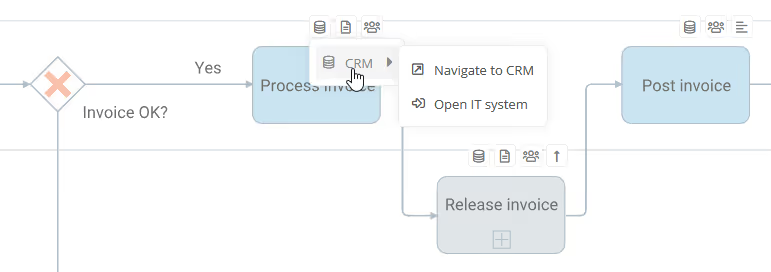
A major advantage of Aeneis is the ability to display system information in a contextual manner. If a user opens a process in the Aeneis portal, he or she not only sees the process steps, responsible persons and documents, but also, if desired, the associated IT systems, including relevant details. This creates transparency in the system landscape: You can see at a glance which processes depend on a specific CRM or ERP system, for example, and can react in a targeted manner in the event of malfunctions. In fact, IT system objects stored in Aeneis can be linked to external systems and opened directly from the portal. For example, a click from the process diagram leads to the web interface of the respective application or to a stored system profile.
Interfaces to third-party systems
Interfaces and integrations also play a key role. Aeneis provides standardized interfaces to exchange data with other tools and thus avoid isolated thinking. You can connect your own applications via the REST API, and ready-made connectors to common systems are also available. Especially in the context of IT management, this means that Aeneis fits into your existing company tool landscape. If you already have a CMDB system or other inventory lists, they can be paired with Aeneis to avoid double entries.
A practical example of its performance is the GoBD module from our partner GoBDDirekt: Comprehensive documentation of IT systems and interfaces in Aeneis increases user acceptance and allows tax processes to be efficiently optimized. It is precisely this principle of mapping all systems centrally, keeping them up-to-date and linking them to business processes that makes Aeneis a powerful tool for EAM. IT managers receive reliable documentation of their system landscape, while process managers are always aware of which tools drive their processes. The result: Governance and transparency are significantly increased because professional and technical perspectives are combined.
In summary, Aeneis supports IT system management by providing a uniform information platform. This drastically reduces complexity and manual effort. Where Excel lists used to be maintained or organizational charts laboriously updated, Aeneis provides reports at the push of a button, such as which processes depend on System X or which systems are assigned to a specific owner. This network is particularly valuable for risk management or information security officers: For example, they can see at a glance which critical assets (processes, systems, data) exist and which risks are associated with them. This turns a static IT register into a dynamic control instrument.

Features of the LeanIX interface in Aeneis
The LeanIX interface in Aeneis seamlessly combines Enterprise Architecture Management (EAM) with Business Process Management (BPM). Specifically, it makes it possible to automatically synchronize applications and interfaces from LeanIX with Aeneis and vice versa to transfer processes from Aeneis to LeanIX. This creates a continuous flow of information between the IT architecture and business processes. For this purpose, Aeneis already provides predefined categories in the meta model so that LeanIX objects such as applications and interfaces can be imported into Aeneis in a structured manner. Changes in LeanIX, such as deleting or archiving applications, are taken into account by the interface: The corresponding objects are automatically deleted in Aeneis or moved to the archive folder and restored with an identical GUID if necessary. Selected process areas can also be marked in Aeneis, which are then exported from Aeneis to LeanIX and made available there as process-relevant information. Overall, the LeanIX interface therefore offers bidirectional integration, which ensures that both systems are always up to date and use uniform data.
You can also find more about this in our LeanIX online help entry.
Benefits of the LeanIX interface in Aeneis
- Holistic view of IT landscape and processes: By integrating LeanIX and Aeneis, companies get a complete overview of their application landscape and business processes in one system. EAM information (e.g. applications, interfaces) and process models intertwine, making connections immediately recognizable.
- Always up-to-date and consistent data: Automatic synchronization ensures that changes in LeanIX or Aeneis are immediately reflected in both systems. In this way, all participants always work with up-to-date, consistent information, without manual double entry. For example, objects deleted in LeanIX are removed or archived in Aeneis at the same time, keeping both platforms in sync.
- More efficient maintenance and less duplication of effort: Thanks to the interface, there is no need to maintain double data for architecture and process data. Applications, interfaces and processes no longer have to be updated separately in two tools — one-time entries are sufficient, which saves time and reduces errors caused by manual transfers.
- Better basis for decision-making: With combined EAM and BPM data, companies can make more informed decisions. The effects of changes in the IT architecture on business processes (and vice versa) are transparent through the integrated view, which supports risk management and strategic planning.
- Easy integration into existing structures: The LeanIX interface is designed to fit smoothly into the Aeneisd environment. Predefined categories and configuration options make it easy to set up, so companies can quickly benefit from connecting both systems.
EAM as a success factor — act now!
Enterprise architecture management with a focus on IT system management is now a must in order to make digital transformation successful and secure. Aeneis shows how it works: The fusion of process and IT documentation and the LeanIX interface creates a vivid image of your company in which all threads come together: processes, systems, risks, compliance. For process managers, risk management officers, information security and QM officers, this means: At last, complete transparency about the IT landscape, clear responsibilities and the ability to react proactively to changes. Challenges such as growing compliance requirements, complex system networks or pressure to increase efficiency are much easier to overcome with an integrated approach.
Take advantage of these benefits and take the next step: Test Aeneis in your own environment or see for yourself. We offer the option of testing the process management software Aeneis 30 days for free, completely without obligation and at your own pace. Alternatively, you can also schedule a live demo, in which our experts show you exactly how Aeneis and the LeanIX integration meet your specific requirements.
FAQ
What specific benefits does EAM with Aeneis offer?
Aeneis combines BPM and EAM on one platform: Processes, IT systems, interfaces, risks and responsibilities are centrally documented, networked and analysed for transparent decisions and reduced complexity.
How does Aeneis support IT system management?
In Aeneis, there is a separate category for IT systems, which is linked to processes, roles and documents. Changes to the system inventory can be maintained centrally and are immediately visible in all relevant processes.
What is the advantage of the LeanIX interface in Aeneis?
The integration synchronizes LeanIX applications and interfaces with Aeneis and, conversely, can transfer processes from Aeneis to LeanIX, for a continuous view of the architecture and process landscape without double entry.
How does Aeneis keep data consistent in LeanIX and Aeneis?
Bidirectional synchronization automatically takes into account changes such as archiving or deletion. Objects are updated accordingly in Aeneis so that both systems are always up to date.
What are the governance and compliance benefits of Aeneis?
Aeneis creates an audit-proof “single point of truth” with versioning, standard reports and clear responsibilities, ideal for audits, regulatory evidence and risk management in regulated industries.
Who benefits the most from Aeneis + LeanIX?
Process managers, enterprise architects, ISB/ISM, QM and risk managers receive a common data basis: Redundancies are reduced, dependencies are transparent, investment and modernization decisions are more well-founded.
How do I start pragmatically?
First, enter success-relevant core processes and critical applications in Aeneis, connect LeanIX, define synchronization rules and set up dashboards/reports. This quickly creates a robust, lively EAM model.