

Before AI arrives, the broom must do its job
Politics, talk shows, and board members seem to agree: AI will fix everything. Productivity up, costs down, skills shortages solved — a nice story.
But then comes everyday life:
- Processes have grown over time and are full of exceptions.
- Knowledge is in people's heads, not in systems.
- Regulations ranging from MaRisk to NIS-2 to ISO 27001 are piling up like mountains of paperwork.
That was also made clear in Larissa Holzki's Handelsblatt AI briefing “If you want to build agents, you should first separate yourself from old systems”: At the AI Summit, many agreed that numerous companies have “bad processes” that AI does not improve, but at best makes faster.
Or to put it in a nutshell:
Bad processes + AI = faster bad processes, just more expensive.
If you work in regulated industries such as finance, critical infrastructure, energy, healthcare, or mechanical engineering, you know that is exactly what no one can afford today.
The "Kehrwoche" process at Mercedes-Benz — and what we should learn from it
A particularly concise image from the Handelsblatt report: the “Process Kehrwoche” (a traditional Swabian system of shared household cleaning duties) at Mercedes-Benz.
Katrin Lehmann, head of IT at the group, has announced a kind of competition:
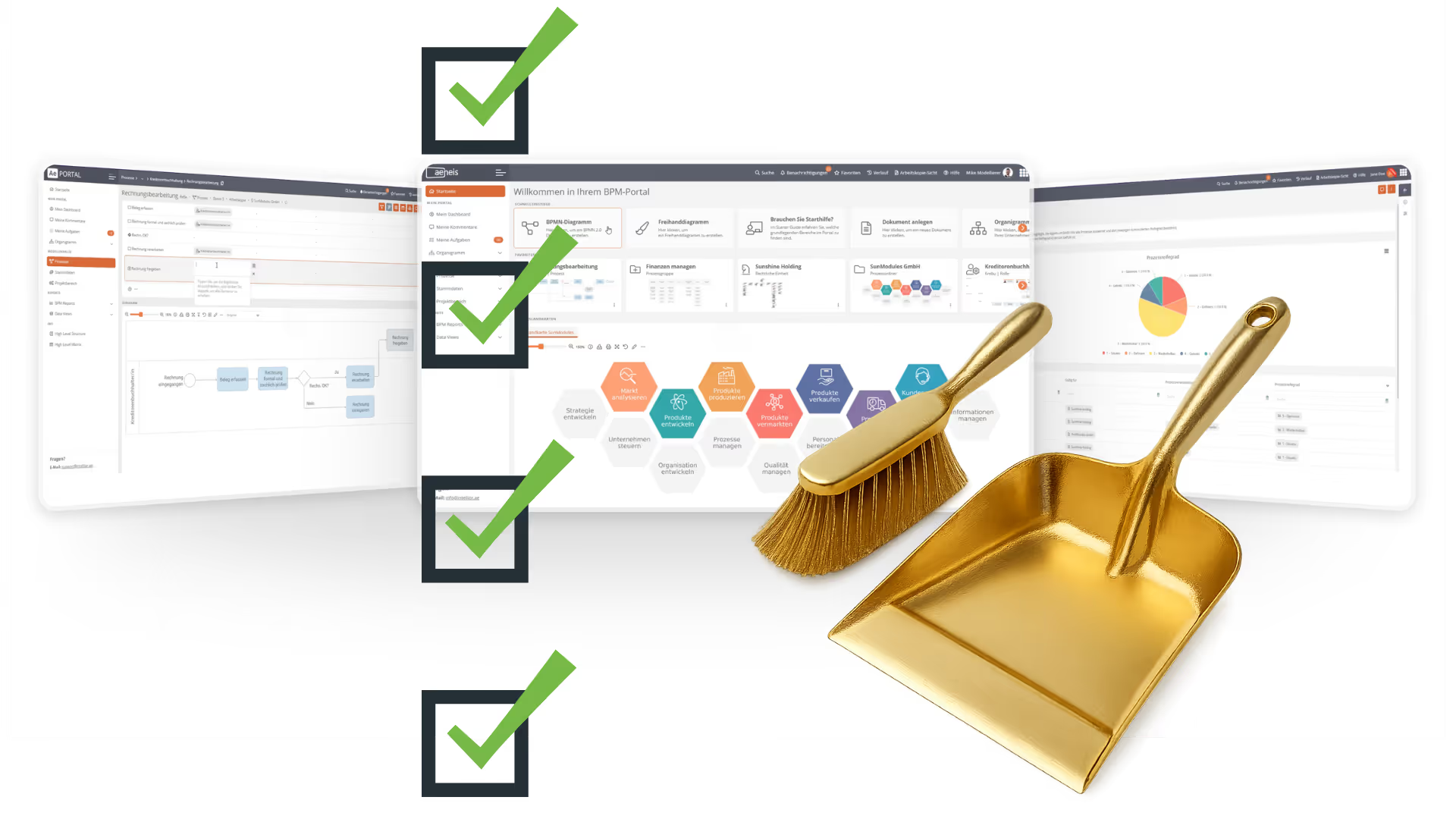
The group is not just about sweeping stairwells weekly, as is the Swabian tradition, but also about consistently getting rid of everything superfluous as part of the big sweeping week—a thorough cleaning. Teams that “clean out” unnecessary processes and legacy systems particularly thoroughly receive a golden dustpan and a team breakfast as an award.

The message behind this is highly relevant:
- Clearing out is becoming a top priority in management.
- Process reduction is just as important as process digitization.
- Before AI agents take over processes, they must be clear, streamlined, and consistent in the first place.
This is because AI agents need consistent and traceable access to data, systems, and processes. If, instead, you have isolated solutions, redundant workarounds, and unclear responsibilities, you will end up with precisely the kind of shadow AI structures that everyone is warning about today.
So the question isn't:
“How quickly can we introduce AI?”
But:
“How thoroughly did we do our process Kehrwoche beforehand?”

Aeneis as a digital process Kehrwoche: Clean up before AI takes over
This is where Aeneis comes in. Intellior's BPM and GRC software Aeneis is a central, process-oriented platform, where you digitally map your organization—including processes, roles, risks, documents, IT systems, and compliance requirements.
Instead of scattered Excel lists, PowerPoint org charts, and local manuals, you create an integrated management system where:
- business processes are modeled according to BPMN standards
- responsibilities and roles are clearly defined
- documents, guidelines, and SmartDocs are linked directly to processes
- risks, controls, and measures are managed within the same model,
- ISMS, BCM, audit management , and data protection run as specialized GRC apps on the same platform.
This makes Aeneis the digital single source of truth for your organization:
For the first time, you can see where processes are duplicated, where media breaks occur, and where risks run through the organization.
Before AI is unleashed on your organization, use Aeneis for:
- Transparency: What happens where, by whom, with which systems and documents?
- Structure: Which processes are truly critical? Which ones can be eliminated?
- Governance: Where are mandatory tasks, where only habits that have developed over time?
And this is exactly where the modern process spring cleaning begins: digital, comprehensible and audit-proof.
Compliance Manager app: The ultimate tool for living processes
Cleaning up processes is the first step. The second, equally important step is: Are these new processes really understood and implemented?
This is where the Compliance Manager app (available from Aeneis 7.5) comes in. It transforms the classic “acknowledgement” into an intelligent, AI-based comprehension check.
1. From “check mark” to real understanding
Many are familiar with it: A new or changed process is being communicated, employees click on “acknowledge” and continue working as before.
The Compliance manager reverses this pattern:
- The AI generates role-related questions based on the complete process context:
- BPMN diagram
- roles & RACI
- linked documents and guidelines
- risks & controls
- IT systems, inputs, outputs, etc.
- Each person receives a personalized compliance check, which checks exactly what is relevant to their role.
This turns passive nodding into active learning and understanding process: Employees must show that they really understand the process and their role in it.
2. Why this is unique
The “magic moment” is created by data networking in Aeneis: Processes, risks, documents, systems and standard requirements are not isolated, but in the same model.
As a result, the AI can:
- capture the entire context of a process
- generate meaningful, role-related questions
- use detailed information that used to be just “nice to have.”
What used to be “embellishments” in the process model, additional texts, notes, risks, links, is now becoming verifiable mandatory information.
Outcome:
- Process knowledge becomes measurable.
- Employees understand their responsibilities better.
- Training is becoming faster and safer.
3. Better protected against compliance incidents
For regulated industries, this is a quantum leap:
- You can prove who understood which process and when.
- You can see how many attempts were needed and where the problem is.
- Dashboards show which departments or roles have knowledge gaps — long before they become audit findings or real incidents.
Continuous compliance is thus becoming part of everyday life:
Checks can be initiated automatically for new processes, versions, risks or documents — not just once in the audit cycle.
The Compliance Manager app is therefore the digital golden dustpan. It ensures that tidy processes are actually put into practice— by everyone, not just on paper.
Teams connector: When processes come to people
The best process landscape is of little use if no one uses it. That is why the Microsoft Teams connector is so important for Aeneis: It brings the integrated management system to where your employees work every day anyway, in Microsoft Teams.
1. Real-time notifications in everyday work
Persistent Aeneis notifications — for example about:
- new or changed processes,
- due tasks, releases or measures,
- comments or inquiries,
are reported directly in Teams. Employees see the information where their daily communication takes place, including the option to jump directly to the object in Aeneis.
2. Favorites & zero friction
In addition, all favorites from Aeneis are displayed in Teams. Relevant processes, documents, or dashboards are therefore just a click away. Thanks to single sign-on and ENTRA-ID integration, there is no need to log in separately — no media breaks, no hurdles.
The result:
- The process portal is used significantly more frequently.
- Process changes reach the right people faster.
- Measures, tests, and releases are completed on time.
In short:
The Teams connector removes the biggest barrier to process optimization: a lack of visibility in everyday work.
When experience retires: Securing boomer knowledge before AI takes over
Parallel to the AI hype, many organizations are facing a silent risk:
The baby boomer generation is retiring, taking decades of experience with them.
The SüdBank AG scenario, as described in the iIntellior blog article “Maintaining knowledge in companies”, is representative of this: The Head of Risk Management knows every subtlety of MaRisk, BAIT, and internal reporting channels, but much of this knowledge isn't in manuals—it's in their head.
If this knowledge is lost, there is a risk of:
- compliance violations,
- process disruptions,
- isolated pockets of knowledge and dependence on individuals.
Here, Aeneis becomes the organization's digital memory:
- Processes are modeled as they are actually performed, including exceptions and special cases.
- Guidelines, work instructions, and SmartDocs are linked directly to processes.
- Roles, responsibilities, IT systems, and risks are linked and versioned.
With the new Compliance Manager, this knowledge is not only documented but actively verified through AI-based comprehension checks.
This creates exactly what many banks, energy suppliers, public utilities, and industrial companies need today:
- Knowledge that depends on processes, not on people.
- Continuous compliance instead of one-off project documentation.
- A robust foundation that makes AI meaningful in the first place.
Why Aeneis is the logical foundation for your AI strategy
If you are serious about AI, you must have done your homework in process management.
With Aeneis, you create the necessary conditions:
- Central BPM & GRC platform: Processes, risks, documents, standards, and systems in an integrated model.
- Living processes instead of paper processes: The Compliance Manager ensures real understanding, not just checkmarks.
- Processes visible in everyday work: The Teams connector brings notifications and favorites directly to Microsoft Teams.
- Knowledge secured for the next generation: Process transparency, versioning and AI-based checks prevent loss of knowledge during generational change.
This is how the idea of “AI solves everything” becomes a reliable strategy:
- Clean up and streamline processes - Your own digital spring cleaning with Aeneis
- Capture, connect and validate knowledge - Transfer experience into digital structures.
- Actively involve employees - via Compliance Manager app and Teams connector.
- Only then should AI agents be placed on a stable, comprehensible process foundation.
Conclusion: Start your digital spring cleaning
As emphasized at the Handelsblatt AI Summit, the train toward AI is far from leaving the station. But those who simply jump on board without tidying up their processes will only end up with even more chaos even faster.
The good news:
With Aeneis, you have everything in your hands to start your own Process Spring Cleaning — structured, comprehensible, and delivering maximum benefits for compliance, efficiency, and knowledge retention.
- Make your processes transparent and optimizable.
- Actively involve employees with Compliance Manager and Teams Connector.
- Secure institutional knowledge and create a robust foundation for your AI initiatives.
Next steps
- Try Aeneis for free and experience for yourself how easy it can be to get started with effective process and GRC management.
- Or directly Schedule a personal live demo, where we show you how to implement your process spring cleaning with Aeneis—from the initial process model to continuous compliance in your daily operations.
This is how AI hype turns into real added value—on a foundation that actually supports you.


FAQs
Why do companies need to clean up their processes before introducing AI?
AI can only work effectively if processes are clearly defined, fully documented, and error-free. Unstructured processes aren't performed better by AI, just faster—often with negative consequences. With Aeneis, companies create a transparent, standardized process landscape that serves as a stable foundation for any AI application.
What does “process spring cleaning” mean in a corporate context?
Process spring cleaning describes the systematic tidying, simplification, and updating of processes, roles, documents, and systems. Inspired by Katrin Lehmann, Head of IT at Mercedes-Benz, it means: eliminating legacy issues, reducing media breaks, and clearly defining processes. Aeneis provides the complete platform to carry out this cleanup in a structured way.
How does Aeneis support companies during their process spring cleaning?
Aeneis centrally maps processes, roles, documents, risks, IT systems, and compliance requirements. BPMN 2.0 modeling, integrated GRC apps, and SmartDocs create a uniform, understandable process landscape. Responsibilities become clear, inconsistencies become visible, and improvements become measurable. Aeneis removes complexity through transparency. With the help of clear reports and interactive relationship diagrams, Aeneis visualizes the connections between processes, risks, IT systems, roles, employees, tasks, and all other master data objects and management system requirements. Aeneis always works with actual master data objects, allowing you to jump from any object view to its properties and networks. The result is total transparency regarding these relationships and lightning-fast data analysis.
Why is Aeneis a vital building block for successful AI projects?
AI requires consistent inputs: clean data, clear processes, and clear responsibilities. Aeneis provides exactly these structures. Only when processes are digitally documented and organizationally anchored can AI intervene meaningfully — for example, through automation, agents, or assistance systems.
What role does the Continuous Manager app play in process optimization?
The Continuous Manager app replaces classic “acknowledgement” with real comprehension tests. The AI generates role-specific questions based on the entire process context. This ensures that employees truly understand processes — a decisive factor for process maturity, compliance, and successful AI implementation.
How does the Teams connector help anchor processes in everyday work?
The Teams connector brings all relevant Aeneis notifications directly to where employees work: in Microsoft Teams. No additional registration, no stand-alone solution. As a result, response times are reduced, risks are identified earlier, and processes are consistently implemented in daily operations.
What risks arise when companies introduce AI without cleaning up processes first?
Incorrect entries, media breaks, shadow processes, and undefined responsibilities lead to AI making wrong decisions or automating inefficient processes. This can cause compliance violations, increased costs, or poor management. A thorough process cleanup prevents precisely these risks.
How does Aeneis help preserve knowledge before experienced employees retire?
Aeneis does more than just document processes — it combines experience, roles, guidelines, risks, and IT systems into a central model. With the Compliance Manager, it is even possible to verify whether knowledge has truly been understood. This is how the know-how of baby boomers remains with the company rather than leaving with the individual.
What makes Aeneis unique compared to other BPM or GRC solutions?
Aeneis combines BPM, GRC, ISMS, BCM, audit management, data protection, and process modeling in a fully integrated platform. The deep data networks enable features such as AI-based comprehension checks, automated compliance, and end-to-end governance — capabilities that other systems do not offer.
How can companies quickly increase their AI readiness with Aeneis?
In three steps:
- Visualize your processes: BPMN modeling in Aeneis.
- Digitally anchor your organization: connect roles, risks, documents, and systems.
- Bringing processes into everyday life: with the Continuous Manager app & Teams connector.
This creates a continuous process culture that forms the foundation for every AI initiative.