.webp)
.webp)
.webp)

.webp)
.webp)
.webp)

.webp)
.webp)
.webp)
.webp)

.webp)
Risk management officers are faced with the demanding task of systematically recording risks, objectively evaluating them and making them controllable across the company. In doing so, they must keep track of numerous sources of information, meet regulatory requirements and involve specialist areas in risk management.
Typical challenges:
The central task: to establish consistent risk management across the company that works both strategically and operationally with clear responsibilities, robust processes and complete transparency of all risks and measures.
With Aeneis, risk management officers have the ideal basis for overcoming these challenges: centralized, process-oriented, integrated with GRC.

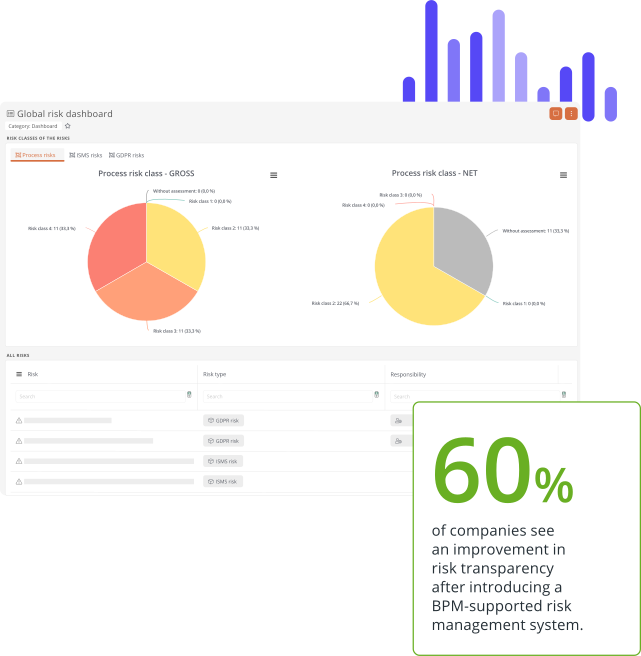

Risk management only has its full effect if it is thought and implemented in a process-oriented manner. This is because risks do not arise in the organization chart, but along your operational processes, where decisions are made, services are provided and data is processed.
Process-oriented risk management means:
Risks are not managed in isolation, but are recorded, assessed and managed directly in connection with the affected business processes. This ensures maximum transparency and allows a realistic assessment of the actual threat situation, both strategically and operationally.
With Aeneis, risks, processes, measures, roles and IT systems are systematically linked together. You recognize early on where risks are taking effect, which processes are affected and which measures are necessary to effectively address these risks.
Process-oriented work ensures clear responsibilities, consistent assessments and sustainable professionalization of your risk management. It creates transparency, improves management and ensures the long-term stability of your company.

Uniformity
Risks, probability of occurrence, measures and assessments are recorded and managed in accordance with a uniform system in the risk management system.

Process linkage
Each risk is directly linked to the affected process, including responsible roles, systems, and documents. This creates maximum transparency in the operational context.

Minimized risks
By planning measures with deadlines, responsibilities and status monitoring, risks can be actively and verifiably minimized with a complete history.

Compliance security
All requirements from standards or industry-specific KRITIS requirements can be mapped in a structured manner and documented in an audit-proof manner at any time. Standards, risks, measures and documents are directly linked to the affected processes for maximum transparency.

Automation
Risk, review and control tasks are generated automatically for less manual maintenance and more efficiency in everyday life.

Centralization
All risk management is carried out in one platform: from risk identification to assessment to implementation of measures, without media disruption and integrated with GRC.


.png)


With Aeneis, you work in an integrated, audit-proof and process-oriented manner. Risks are not only listed, but also intelligently linked to processes, roles and measures.
You can define your own evaluation criteria or draw on best practice models. You can then individually assess each risk according to its gross and net probabilities and effects (before and after the implementation of measures). The risk class is then automatically determined.
Yes, Aeneis offers a well-thought-out standard, but it can be adapted to your requirements.
Absolutely. Aeneis supports you in meeting your documentation requirements, ensuring information security, business continuity, and internal control systems in a centralized, structured and traceable manner.
Thanks to a modular structure, preconfigured templates and support from intellior experts, a productive start is possible in just a few weeks.