Cyber attacks, cloud services and new regulations such as DORA or NIS-2 are fundamentally changing the security landscape in the financial sector. With ISO/IEC 27001:2022, the world's most important standard for information security management systems (ISMS) has been modernized and brings new requirements for governance, processes and technical measures.
For banks, insurers and financial service providers, this means that anyone who has not yet completed the migration must take urgent action now. Because since October 2025, the old certification version has finally expired and only an ISMS in accordance with the current standard remains auditable and recognized.
In this article, you can read how financial institutions implement the changes in a practical and efficient manner and how the BPM and GRC software Aeneis supports them in doing so.
Why adapting to ISO 27001:2022 is now a priority for financial institutions
The financial sector is one of the most heavily regulated sectors of all. In addition to BaFin supervision and MaRisk requirements, institutions must increasingly also comply with EU directives such as DORA or NIS-2. All of these regulations have a common denominator: They require a demonstrably effective ISMS that systematically identifies, assesses and manages risks.
With the switch to version 2022, security controls were modernized, focused more on cloud environments and digital business models, and divided into four clear categories. Anyone who still works with outdated structures risks not only audit deviations, but also operational risks in the IT and process landscape.
The good news: A process-oriented platform such as Aeneis makes it possible to systematically map the new requirements, from gap analysis to action planning and audit-proof verification.
An overview of the most important changes to ISO 27001:2022
ISO 27001:2022 is the first major update in almost ten years and it brings noticeable changes. The aim of the new version is to structure information security more clearly, to map digital risks and to integrate the standard more closely with modern management systems.
New structure of security controls
Instead of 114 controls in 14 domains, there are now 93 controls in 4 areas:
- Organizational — Governance, policies, risk management
- People — Training, awareness, responsibilities
- Physical — Physical security measures
- Technological — Technical protection and monitoring measures
The new structure simplifies the application and supports an integrated view of information security, particularly relevant for banks and insurance companies with complex process landscapes.
Eleven new controls for current risks
The standard responds to modern threats and technological developments. Among other things, the following were newly introduced:
- Threat Intelligence (5.7): systematic evaluation of threat information
- Cloud Security (5.23): secure use and control of external cloud services
- Data Masking (8.11) and Data Leakage Prevention (8.12): Protecting sensitive data
- Monitoring Activities (8.16): continuous monitoring of safety-related events
- Secure Coding (8.28): secure software development and code testing
For financial institutions, this means more clarity in the implementation of regulatory requirements, in particular with regard to DORA, MaRisk AT 7.2 and BaFin's IT supervision.
Further adjustments and simplifications
- Unified terms: e.g. a more precise definition of “assets”
- Merged controls: less duplication, clearer responsibilities
- Small but practical changes in chapters 4—10, for example at:
- Interested parties (4.2)
- Planning changes (6.3)
- Documented information (7.5)
More integration and traceability
- ISO 27001:2022 promotes links with other standards such as ISO 9001, ISO 22301 or ISO 31000.
- Digital tools are explicitly seen as enablers for verification and continuous improvement.
- For banks and insurance companies, this opens the way to an integrated ISMS that combines auditability, efficiency and regulatory compliance.
- With a solution like Aeneis, these requirements can be translated directly into processes, workflows and reports, audit-proof, automated and auditable.
What the changes mean for the financial sector
For banks, insurance companies and financial service providers, ISO 27001:2022 tightens the requirements for governance, risk and information security management. The new controls, such as cloud security, monitoring and threat analysis, directly interfere with existing MaRisk, DORA and BAIT requirements.
Institutes that have previously managed their ISMS in isolation must now think about information security in a process-oriented and integrated way. A recent study by Kariuki et al. (2024) shows that banks that systematically implement ISO 27001 significantly improve their risk transparency and response speed. At the same time, researchers identify a lack of integration and unclear responsibilities as the most common obstacles to implementation.
Anyone who relies on a platform such as Aeneis for this purpose can map regulatory requirements, processes and evidence in a central system.
How Aeneis helps financial institutions implement ISO 27001:2022
The new requirements of ISO 27001:2022 can only be met efficiently if information security, processes and compliance are brought together in a common system landscape. That is exactly what Aeneis does:
As an integrated BPM and GRC platform, Aeneis combines process management, risk management, ISMS and audit management in a central system, ideal for the regulatory demanding financial sector.
1. Process-oriented implementation instead of document chaos
Instead of maintaining security measures in isolated tables, Aeneis maps the ISO 27001 controls directly in the process architecture.
- Each process can be assigned to the relevant controls, risks and measures. This makes it clear where safety requirements have an effect in day-to-day business.
- Changes in processes or systems are comprehensibly incorporated into the ISMS documentation.

For banks and insurers, this means that the often separate worlds of process management, IT risk management and information security are merging to form a holistic control model.
2. Action management and follow-up
Implementing the standard requires consistent management of measures. In Aeneis, these can be managed centrally, assigned to responsible persons and followed via workflows.
- Status and progress are comprehensible at any time.
- Reminders and notifications support timely implementation.
- The measures can be linked directly to processes, risks and controls without tables and media breaks.
The result is an integrated system that combines responsibility, transparency and efficiency. The research by Solms et al. (2023): “Adoption of the Information Security Management System Standard ISO/IEC 27001: Motives, Impacts, Barriers. ” also shows that companies with clearly structured action management and digitally supported ISMS achieve significantly better results in audits and implement security requirements more sustainably.
3. Verification and audit support
ISO 27001 requires comprehensive documentation and Aeneis creates it digitally and centrally:
- Standardised reports (such as SoA reports, management reports, or audit logs) can be generated directly from the system.
- All changes are documented in an audit-proof manner, which means that the audit trail requirement is met.
- Auditors can access relevant processes, risks and documents in a targeted manner without media disruption.
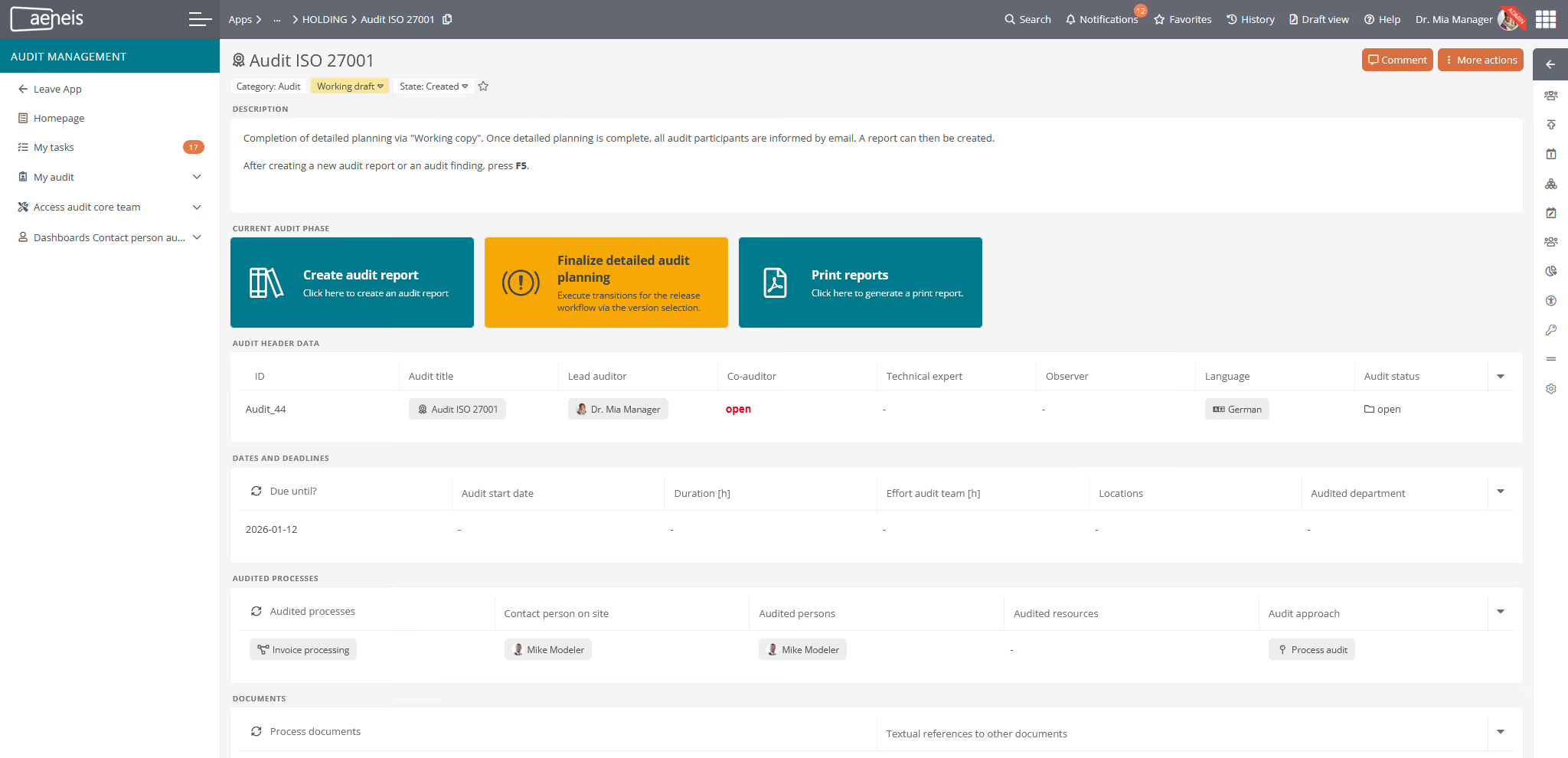
This not only reduces audit costs, but also improves the quality and traceability of safety control.
4. Integration with existing management systems
Many financial institutions already have management systems in accordance with ISO 9001, ISO 22301 or ISO 31000. Aeneis harmonizes these systems using a uniform high-level structure (HLS).
- The requirements of various standards are presented in a consistent structure.
- There is no need for multiple documentation and redundant checks.
- Security, quality, business continuity, and compliance are seamlessly intertwined.
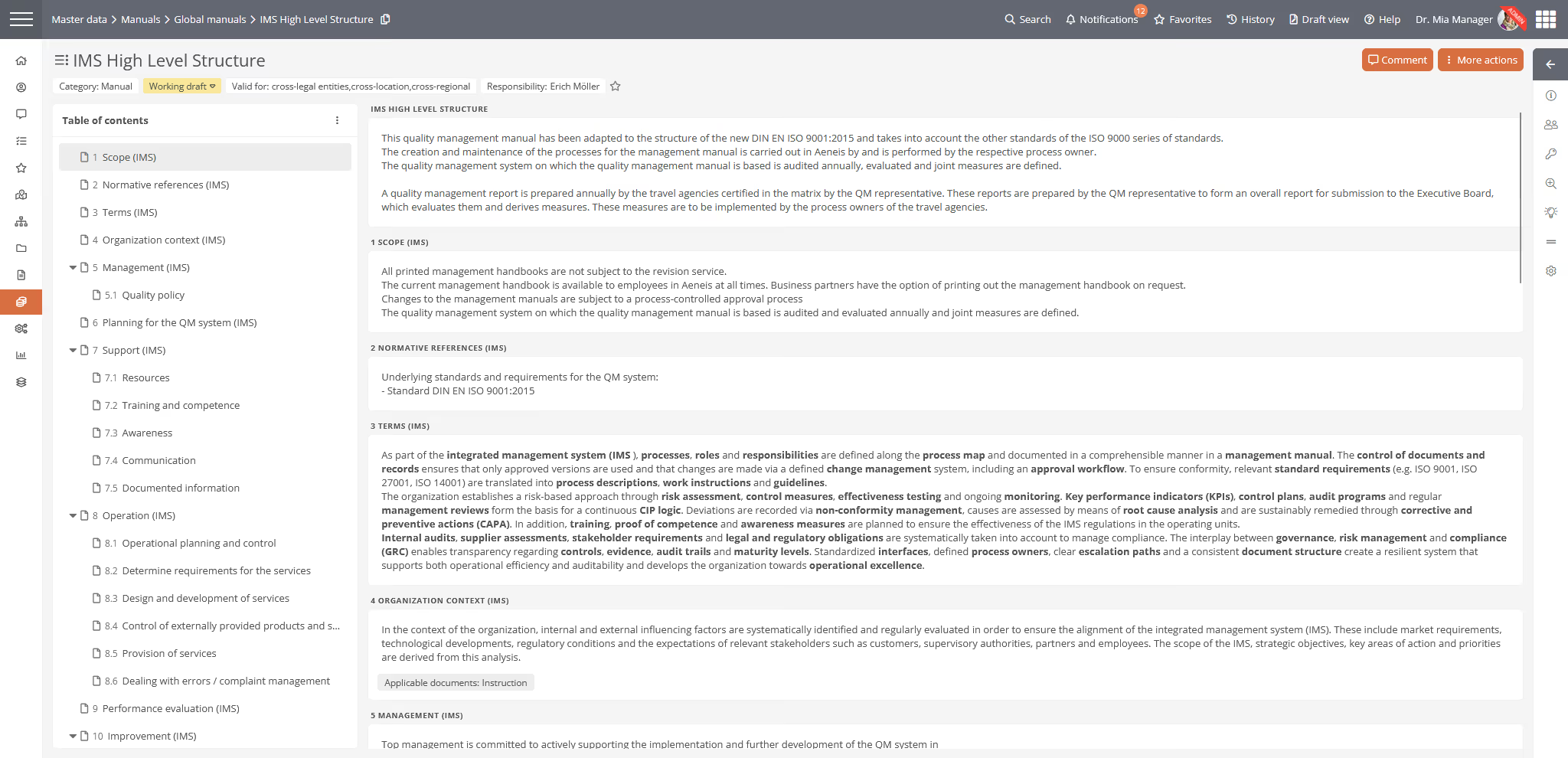
The result is an integrated management system (IMS) that not only complies with standards, but is also strategically valuable.
ISO 27001:2022 as an opportunity for integrated information security
ISO 27001:2022 marks a turning point for financial institutions: Information security is becoming a strategic management task. Anyone who sees the new requirements only as an obligation is wasting potential, because with the right system, the standard can become the basis for greater transparency, resilience and trust.
With the Aeneis BPM and GRC software, you can design, control and document information security in a process-oriented manner. Instead of building new structures alongside existing ones, Aeneis integrates ISO controls, regulatory requirements and processes into a single digital system. The result is verifiable compliance, less effort and more security in day-to-day business.
Act now
The transition period for the new standard has expired; now it's time for implementation rather than postponement. Take the opportunity to make your ISMS fit for the future and integrate information security into your process landscape.
Schedule a live demo to see how you can implement the requirements of ISO 27001:2022 in your organization digitally and in an auditable way.

FAQ s
What is ISO 27001:2022?
ISO 27001:2022 is the international standard for information security management systems (ISMS). It defines requirements with which companies can systematically protect their information assets. The current version of 2022 modernizes security controls and strengthens integration into business processes.
With a software solution such as Aeneis, this integration can be made centralized and transparent.
What has changed with the new ISO 27001?
The number of security checks was reduced from 114 to 93, structured into four subject areas: organizational, people, physical and technological. Eleven new controls have been added, for example for cloud security, threat intelligence and data masking. The Aeneis software helps you to clearly assign these controls and to map their implementation in the processes.
Why is ISO 27001 particularly important for financial institutions?
Financial institutions are subject to strict supervisory rules such as MaRisk, DORA and BAIT. ISO 27001 provides the internationally recognized framework for managing information security in a comprehensible manner. With the ISMS in Aeneis, these regulatory requirements can be bundled in an integrated management system and documented in an auditable manner.
How can ISO 27001 be implemented efficiently?
The key lies in clear processes, clear responsibilities and digital traceability. A central platform such as Aeneis combines process management, risk and ISMS management — creating a consistent, auditable information security process.
What are the benefits of an ISO 27001-compliant implementation with Aeneis?
- Uniform database for processes, risks and controls
- Automated documentation and evidence for audits
- Clear responsibilities and transparent action tracking
As a result, information security is not a compulsory exercise, but a measurable contribution to corporate management.