
A process map provides a comprehensive overview of a company's business processes. In process management, it serves as a central navigation tool that creates transparency, clarifies responsibilities and forms the basis for continuous improvement. With the Aeneis BPM software, companies can effectively visualize and control their process landscapes.

.webp)
.webp)
.webp)

.webp)
.webp)
.webp)

.webp)
.webp)
.webp)
.webp)

.webp)
A process map is a higher-level, visually structured overall presentation of a company's business processes. It shows in abstract form how management, core and support processes come together to form a holistic value chain and thus forms the backbone of the corporate architecture. The focus is in particular on critical and success-relevant processes, i.e. those processes that are decisive for achieving strategic goals and compliance with regulatory requirements (such as those from ISO 9001).
In contrast to detailed process models, the process map focuses on the big picture: It provides a compact, strategic overview of all relevant process areas and illustrates how the company works overall.
As a central management tool, the process map helps both management and employees to clarify responsibilities, understand relationships and identify potential for improvement. It is the starting point for in-depth analyses, the basis for active process organization and a valuable tool in the context of digitization, governance, risk & compliance (GRC) and quality management.
For regulated or particularly complex organizations — such as KRITIS companies, healthcare institutions, energy suppliers or public utilities — the process map can offer real added value. Especially when clear processes, secure procedures and comprehensible responsibilities are required.
The process map serves several purposes:
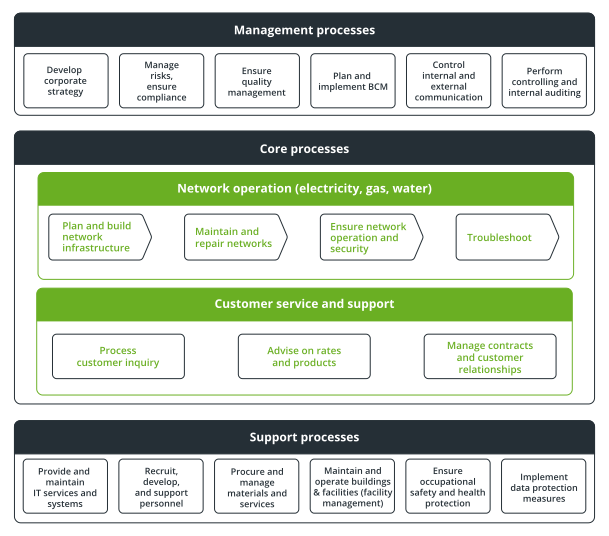
A process map is often structured according to an established three-part division that has proven itself in many organizations. It divides all processes relevant to success into three main categories:
These layers are usually displayed horizontally or vertically and are structured by a clear, graphical division. Depending on the target group and context, the process map may be more strategically abstract or more operationally specific. It is important that it remains easy to understand and enables intuitive orientation.
A good process map is not only a static overview, but also functions as an interactive navigation tool. In Aeneis, individual processes are directly linked to more detailed models, documents, roles or key figures. This creates a dynamic image of the process architecture that can be flexibly adapted to new requirements, from a simple overview to detailed process analysis
Creating a process map in Aeneis involves several steps:
1. Identifying processes: Systematically record critical and success-relevant business processes. Top-down or bottom-up approach? We would be happy to advise you!
2. Structure: Assign processes to the three main levels (management, core and support processes).
3. Visualize: Presentation of processes in Aeneis with manually created freehand diagrams or with automatically generated column diagrams.
4. Link: Link processes to documents, IT systems, and responsibilities.
5. Publish: Deployment in the company portal for company-wide use.
Aeneis supports this process with an intuitive user interface and extensive modeling functions.
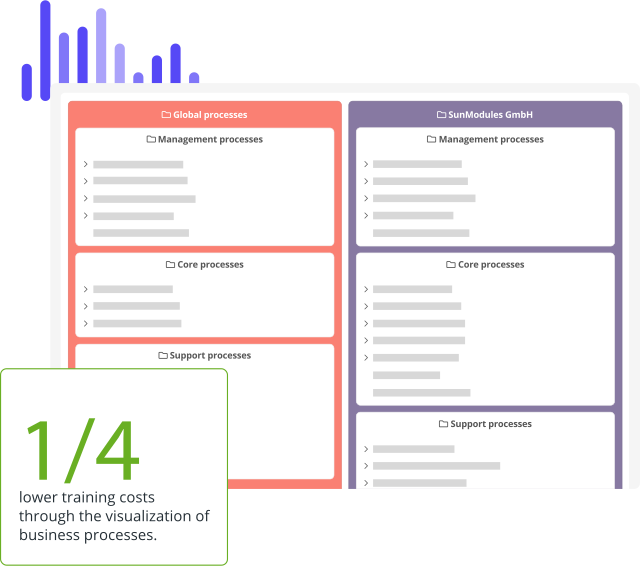
A typical example of a process map in Aeneis shows the main processes of a company in a clear, hierarchical structure. Freehand charts allow you to customize the map. The link to detailed process models allows intuitive navigation and a deep understanding of the relationships depicted. Even complex process landscapes remain clear and easy to understand.
The following errors often occur when creating process maps:
These mistakes can be avoided if a clear objective, a well-thought-out structure and a suitable software solution such as Aeneis are used right from the start.

It should provide an overview without going into the depth of individual processes. Detailed information should be available via links.
Usually specialist areas in cooperation with process organization or quality management.
Regularly, at least annually or in case of major organizational changes.
Ideally via a web-based portal such as the integrated business portal Aeneis.


.avif)


