Digitalization is shaping today's business world at an unprecedented pace and scale. Artificial intelligence (AI) is at the forefront of this revolution by helping companies optimize their processes, minimize risks, and ensure compliance. AI should no longer just be seen as a trend, but should be integrated into the modern corporate landscape as a supporting tool in the future.
In this blog article, we would like to show you how important artificial intelligence is for companies in the 21st century and what role AI can play as a supporting tool in BPM and GRC.
Find out how Intellior implemented the topic of artificial intelligence in the Aeneis BPM software here.
Disclaimer: At the outset, we would like to make it clear that artificial intelligence cannot perform tasks independently. AI is no substitute for human work and thinking. The possible uses of AI in the area of Business Process Management (BPM) and Governance, Risk Management and Compliance (GRC) relate only to supporting people as part of our blog article. While AI can provide valuable insights and suggestions that contribute to inspiration and increasing efficiency, the information and recommendations generated should always be regarded as a basis or starting point. It is essential that all artificial intelligence suggestions are reviewed and validated by experts before they are integrated into business processes. The ultimate responsibility for decisions and implementation always lies with the human actors in the company.
Artificial intelligence in the modern corporate world
The integration of artificial intelligence into the business processes of modern companies is no longer a future scenario — it is a reality. Welcome to the future!
Artificial intelligence has countless abilities. AI tools can help to process large amounts of data or even recognize patterns. In addition, AI can learn from experience — almost as we humans do. These capabilities enable today's companies to optimize their processes, drive innovation and strengthen their market position with the support of AI.
This is what AI can do in companies:
- Processing large amounts of data: With the help of AI systems, people can process and analyze information faster, which leads to more precise decisions in less time.
- Pattern recognition and predictions: By analyzing past and present data, AI can be used to identify trends and estimate future developments, which helps companies to act proactively.
- Automation and efficiency enhancement: The use of artificial intelligence makes it possible to automate repetitive and time-consuming tasks, which allows employees to focus on more complex and value-adding activities.
- Personalization: AI can help drive innovation and better tailor a company's products or services to the individual needs of customers.
Strategic benefits of AI for companies:
- Agility: AI-powered systems can react quickly to changes in the market, which helps companies remain competitive.
- Innovative power: By using AI, employees in companies can further expand their ideas, develop new solutions and optimize existing offerings.
- Risk management: Artificial intelligence can help identify potential risks at an early stage and initiate countermeasures, thereby protecting the stability of the company.
- Cost savings: By optimizing processes and reducing manual intervention, companies can achieve significant cost savings. It should be noted that artificial intelligence cannot replace jobs, but only supports employees in a company.
Importance of AI in digitizing business processes
The integration of artificial intelligence plays a central role in the transformation and digitization of business processes. By implementing AI technologies, companies can not only make their processes more efficient and cost-effective, but also improve the quality of their services and products.
In essence, AI relieves employees by providing support, in particular, with repetitive and data-intensive tasks. It enables professionals to focus on creative, strategic, and interpersonal tasks that machine learning and automated systems cannot replace. In addition, the integration of AI into business processes promotes data-driven decision-making, making companies more agile and adaptable to market changes.
AI in process management
In the area of process management, AI is a powerful tool that employees in companies can use to improve both the efficiency and effectiveness of business processes. By using advanced data analysis, machine learning, and automation technologies, artificial intelligence can help take business process management to a whole new level.

How important is BPM for companies
Artificial intelligence for BPM? Do you even need business process management? What role does AI play for your BPM?
Today, no modern company can ignore process management — and that's a good thing! Finally, BPM helps to increase the efficiency, flexibility and transparency of business processes.
In the following, we have broken down what we consider to be the most important goals of BPM:
- Increasing efficiency: Standardizing processes and eliminating inefficiencies are essential to make optimal use of resources and maximize productivity. An efficient process reduces time and costs and increases the competitiveness of the company.
- Transparency: Ensuring clarity about process flows and responsibilities is fundamental for the traceability and trust of all parties involved. Transparent processes make it possible to identify weak points, promote communication and facilitate cooperation within the company.
- Adaptability: In a fast-paced business world, the ability to quickly adapt processes to changing conditions is crucial for long-term success. Flexible processes allow companies to react to market dynamics, seize opportunities and minimize risks.
- Continuous improvement: The regular analysis and optimization of processes not only ensures that business processes are up-to-date and relevant, but also promotes innovation. A culture of continuous improvement drives efficiency and strengthens a company's ability to adapt and compete.
The needs of BPM and continuous process optimization are obvious. This is the only way companies can remain agile and respond effectively to market dynamics. AI can significantly facilitate these processes through data-driven insights and automation.
Role of AI in Business Process Management (BPM)
In business process management, artificial intelligence primarily serves as support that offers employees innovative approaches and data analyses to increase the efficiency and competitiveness of companies. In particular, AI can be used as part of BPM software to generate sample processes that serve as a source of inspiration and a benchmark for optimizing existing processes. These generated process models enable employees to gain new perspectives, critically reflect on their own processes and identify potential for improvement.
By providing suggestions for process improvements, specialists can analyze them, adapt them to the specific needs of their company and thus drive continuous improvement cycles.
It is important to understand that AI is not an autonomous decision-making body in this context, but a tool that processes data, shows patterns and makes suggestions. The final assessment, decision and implementation of process improvements remains up to human experts, who contribute their professional knowledge and context to effectively use the information provided by AI.
Benefits of AI-supported process management
The integration of artificial intelligence into process management develops a range of potentials that help companies to reflect and further develop their processes. AI serves as a tool that provides employees with valuable insights and suggestions. This support enables companies to rethink processes, make them more effective and thus ensure their competitiveness in the long term. Through the intelligent analysis options offered by AI, companies can gain data-based inspiration and make well-founded decisions that lead to measurable improvements.
In the following sections, we would like to illustrate the benefits of AI-supported process management using a specific example. In doing so, we focus on the onboarding process of new employees in a company.
Increasing efficiency through inspiration in the onboarding process
Artificial intelligence can help to analyze various onboarding processes from various industries. Patterns can then be identified on this basis. For example, it could be found that an interactive e-learning module leads to faster onboarding of new employees.
Companies could use this insight to incorporate interactive elements into their onboarding process, which significantly shortens the training period and allows employees to become productive more quickly. With the help of AI-generated suggestions, those responsible can continuously adapt and refine the training processes, which indirectly leads to an increase in efficiency throughout the company.
Quality improvement as a goal in the onboarding process
AI can analyze historical data from onboarding processes to identify common stumbling blocks or misunderstandings that new employees have experienced in the past. By uncovering such patterns, certain information can be communicated earlier or more clearly during the onboarding phase.
If HR teams implement these changes, this can significantly increase the quality of the onboarding process, increase the satisfaction of new employees and improve their loyalty to the company in the long term.
Transparency through data analysis in the onboarding process
By analyzing data, AI can help bring more transparency to the onboarding process, for example by showing which steps are particularly time-consuming or where new employees have the most common questions.
These insights make it possible to make targeted improvements. For example, AI could recognize a pattern that new employees often have problems accessing certain IT resources. In response, IT and HR could work together to develop a clearer and more detailed guide for this step, speeding up the onboarding process for future newcomers and improving their initial experiences with the company.

AI in Governance, Risk Management, and Compliance (GRC)
In today's dynamic business environment, governance, risk management and compliance (GRC) are key elements of sustainable corporate governance. Artificial intelligence reinforces the effectiveness of GRC by, among other things, helping to streamline processes. Integrating AI capabilities with GRC enables companies to be proactive rather than just responding to challenges.

GRC basics for companies
At its core, GRC comprises three pillars that are essential for the stability and integrity of a company:
- Governance: Ensures effective corporate governance and decision making.
- Risk management: Identifies, assesses, and manages risks to prevent damage.
- Compliance: Ensures that companies comply with all relevant laws, guidelines and standards.
These elements are fundamental building blocks for sustainable corporate success and the basis for responsible corporate governance.
Using AI in GRC strategies
Artificial intelligence can be used in various areas of GRC. Some examples of using AI in a GRC context include:
- Risk analysis: With the support of AI systems, larger amounts of data can be analyzed to quickly identify and assess risks. For example, a financial services company can use AI to identify patterns from millions of credit records that indicate an increased risk of default and thus make credit granting processes more precise.
- Compliance monitoring: Artificial intelligence enables continuous compliance monitoring by identifying changes in regulations and automatically notifying the company of them. In a pharmaceutical company, this could mean AI verifying compliance with new international regulations for clinical trials and raising the alarm if there are deviations.
- Decision support: AI provides data-based recommendations that help decision makers make well-founded decisions. For example, a manufacturing company could use AI to obtain recommendations from a wealth of data as to which technology investments would increase production efficiency the most.
Benefits of AI-powered GRC
The implementation of artificial intelligence in governance, risk management and compliance (GRC) is a milestone on the path to progressive corporate governance. AI technologies can help employees enrich traditional GRC processes to make them even more efficient, accurate, and responsive.
Companies that integrate artificial intelligence as a tool into their GRC systems can position themselves at the forefront of technological innovation, ensure their competitiveness and strengthen their market position.
Assisted risk detection through AI analytics
In GRC systems, AI can help employees extract relevant information from large amounts of data. Through machine learning and pattern recognition, AI systems can highlight emerging risks that human analysts might otherwise miss.
Although AI improves the accuracy and speed of risk detection, the final assessment and decision-making remains with experts. AI suggests possible risk scenarios on the basis of which employees can make well-founded decisions and plan proactive measures.
Helping you manage compliance with AI
AI technologies act as an assistant in compliance management by enabling continuous monitoring and analysis of regulatory requirements. They identify and report discrepancies or potential violations, which allows employees to react immediately.
With the help of AI systems, compliance officers can monitor regulatory compliance more efficiently and reduce review efforts, while the final decision on what action to take remains in their hands.
The technology provides insights and recommendations that decision makers can use to optimize their strategies and processes and ensure compliance.
BPM and GRC with new AI features from Aeneis
Of course, we at intellior GmbH also know how important artificial intelligence is in our modern age. That is why we would like to present the new AI features of our process management software Aeneis, which are available to you from version 7.2.
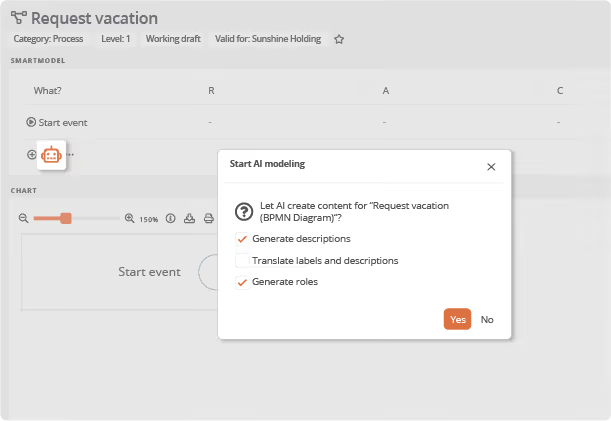
The AI features in Aeneis can help you model business processes at the click of a button. Plus you can simply ask your questions about Aeneis to our new AI help bot and get answers in seconds. So if you have questions about a specific area or an explicit feature while using Aeneis, you can consult our bot directly in the predefined chat window.
AI in Aeneis — The benefits for you at a glance
- Innovative process modeling: The AI modeling function makes it possible to create customized process models by suggesting example processes that can be integrated into the current process landscape.
- Detailed process descriptions: For every step in the process model, the AI provides detailed descriptions, giving users comprehensive information to better understand and implement processes.
- Assignment of responsibilities: With the help of AI, it is easier to define roles and responsibilities within process flows, which promotes a clear structure and efficient process execution.
- Multi-language localization: The ability to offer processes in various languages supports the global application of Aeneis, which allows companies to establish internationally standardized processes.
- Answers to your questions: If you have any questions about our BPM software Aeneis, you can contact our HelpBot around the clock. As a result, you will no longer have to browse through our online help in the future, but will receive all the answers to your questions in the chat window.

These advanced AI features make Aeneis an even more powerful tool for BPM and GRC.
Learn more about AI in process management!
Conclusion: Future-proof corporate management with AI
Finally, we note that in today's era of digitization, artificial intelligence plays a decisive role in the transformation and digitization of business processes and governance, risk management and compliance (GRC). The support of AI enables companies to build their process landscape on an AI-generated database, get inspiration for their process modeling and optimization, and make their processes available in various languages within seconds.
With our process management software Aeneis, we also rely on AI functions to revolutionize BPM and GRC. With Aeneis, we offer companies a comprehensive solution to digitize their processes, identify risks and meet compliance requirements. By implementing the BPM tool, not only can operational processes be improved, but strategic decision-making can also be strengthened. Aeneis helps modern companies become more efficient, more digital and remain competitive.
Now let's take a look at the future: In our opinion, artificial intelligence is still just getting started. AI will play an even more central role in business models and corporate structures in the future. Companies that invest in AI technologies and systems at an early stage position themselves at the forefront of technological innovation and ensure their future viability in an increasingly digitalized world.
You too can rely on AI applications as support in everyday business life so that you not only survive in the here and now, but also to successfully prepare yourself for the challenges and opportunities of the future.
FAQ
What are the benefits of AI in process management?
Artificial intelligence helps companies analyze large amounts of data, recognize patterns, and automate repetitive tasks. This makes processes more efficient, transparent and easier to control.
In Aeneis AI supports process modeling by automatically generating an initial BPMN draft from a simple process name. This design can then be refined manually or with the help of AI, saving teams time and gaining inspiration for new, optimized process flows.
Does AI replace human decisions in BPM and GRC?
No, AI doesn't replace human decisions. It provides analyses, recommendations and templates that serve as a basis for well-founded decisions. Responsibility for implementation remains with the specialist departments.
In Aeneis, this approach is consistently implemented: AI functions support users with suggestions and process designs, but every decision, from approval to implementation, remains with humans. Versioning and role management ensure that decisions are always made comprehensibly and responsibly.
How do companies start securely with AI in BPM and GRC?
A secure start is achieved when companies start small, define pilot projects and carefully evaluate the results. Clear guidelines for quality, data protection and responsibilities should be set.
The Aeneis BPM software provides the ideal framework for such projects: The platform integrates AI functions into existing processes in a controlled manner, automatically documents every change and thus ensures maximum transparency and traceability.
How can companies meaningfully integrate AI into their process and compliance management?
Companies should use AI where it creates tangible added value, such as in analyzing, documenting or optimizing processes. It is important that AI serves as support for employees and not as a substitute for professional decisions. With Aeneis, this integration is particularly practical: The software combines AI functions with clear structures in process and compliance management. This allows organizations to utilize automation potential without losing control or transparency.