Companies are often faced with the challenge that their organizational and process data is distributed across various, isolated systems. Responsibilities are unclear, interfaces are confusing. Overcoming this fragmentation is crucial to ensure efficient busniess processes and optimize communication within the company. With Aeneis, you can overcome this challenge. In the platform, you can record individual elements of organizational management, seamlessly integrate various management systems and intelligently link all data together. In this article, you'll learn how Aeneis can simplify and even improve your operational processes through tailored features and user-friendly interfaces.
Integrated management systems:
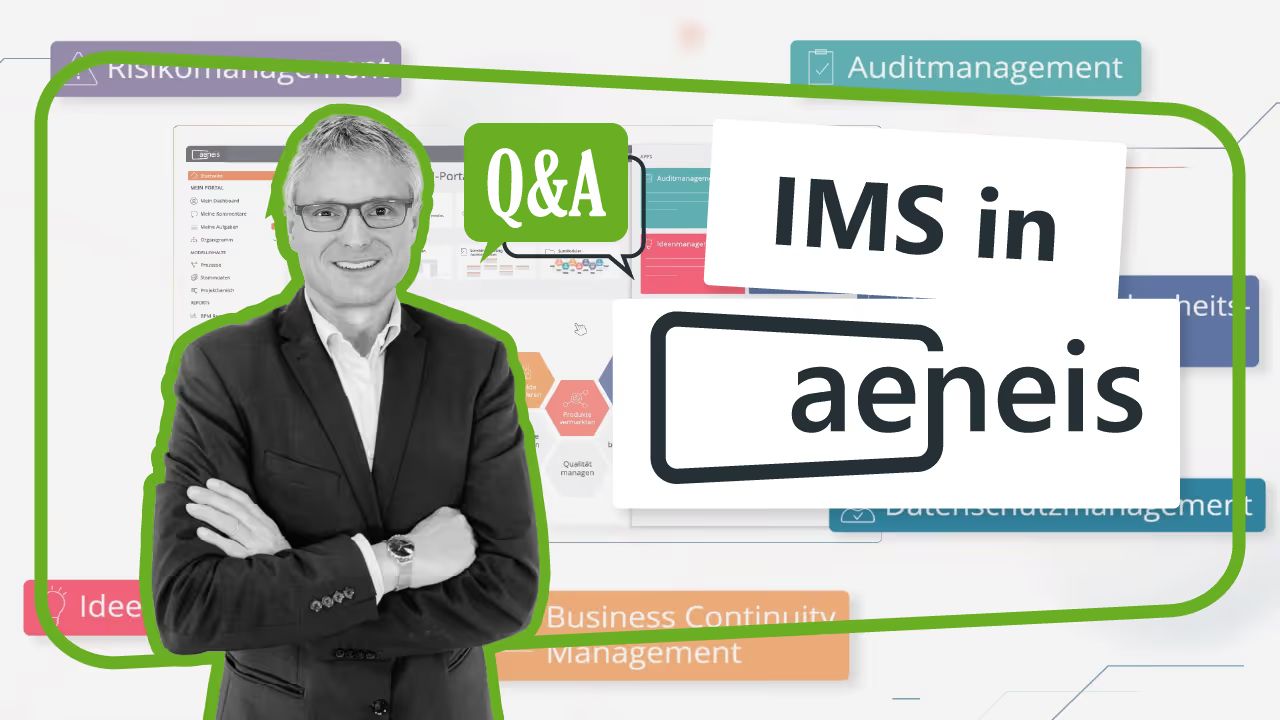
An integrated management system (IMS) combines several individual management systems, such as process management, audit management (ISO 19011), information security (ISO 27001), data protection or risk management, in a common structural and process-oriented platform. Instead of parallel structures, an IMS pursues the goal of using synergies, avoiding redundancies and managing joint processes, roles and measures across the board.
The integration ensures efficiency, better collaboration and auditability, and a uniform understanding of responsibility and regulatory compliance within the company. For an IMS to work, it needs a system that consistently maps and links all standard requirements; the BPM and GRC software Aeneis fulfills exactly this role.

Aeneis as a single point of truth
The key lies in the Aeneis information model. The software links all relevant objects in organizational and process management and thus creates a central Single Point of Truth. This makes Aeneis a platform that makes all data consistent, transparent and evaluable — without media breaks or redundant data storage.
Why a single point of truth is crucial
In many organizations, information is distributed across different systems: HR systems contain roles and employees, IT systems provide information about applications, document management systems store requirements, while Excel lists manage risks or measures. This fragmentation makes management difficult and makes companies vulnerable to errors or inefficiencies. Aeneis solves this problem by combining all objects in a uniform model and making the relationships between them visible. This creates the basis for a truly integrated management system.
Connected information in detail
- Processes & responsibilities: Each task is assigned to a role and specific people. In this way, it is always clear who has which responsibility, which is a central requirement of all ISO standards.
- IT systems: Processes are linked to supporting applications. This makes it possible to identify dependencies and answer questions such as: Which system supports which process? What happens in the event of an outage?
- Automated permissions: Since it is clear which role fulfills which task with which system, authorizations can be derived directly from Aeneis. This saves time and increases compliance security.
- Documents & regulations: Process steps are linked to relevant documents, guidelines and standards requirements. Employees can find information exactly where they need it.
- Risks & measures: Risks are presented transparently, measures are documented and linked to processes. Results from audits are also incorporated into the model and can be traced.

Benefits for the company
- Transparency: All parties involved work with a consistent database.
- Efficiency: Redundancies and multiple maintenance are eliminated.
- Traceability: Versioning and history ensure complete traceability.
- Strategic added value: Decisions can be made on the basis of well-founded, up-to-date information.
- Compliance with standards: Requirements from various standards are brought together in one system.
The result: A consistent information model that has met every requirement so far and can be flexibly expanded thanks to the open meta model.
Visualize data
A consistent information model only develops its added value through transparency and evaluability. Aeneis offers a wide range of tools for this, which support both operational users and strategic decision makers and are essential for an IMS.
Dynamic dashboards
The dashboards in Aeneis visualize relationships, dependencies, and key figures in real time. Risks, measures or process progress are presented interactively and can be filtered or recombined as desired. This creates overviews that are ideal for management reviews or continuous improvement processes.

Filter lists and exports
In addition to visual representations, classic tabular views are also integrated. Using filter lists, users can flexibly sort data by roles, processes or systems, for example. With one click, these lists can be exported to Excel, where further analyses — such as pivot evaluations — can be carried out. Aeneis thus combines professional data management with the flexibility of familiar office tools.
Standard reports and print reports
Aeneis provides standardized reports for audits, management reviews or certifications. These can be issued in the company's corporate design and provide structured evidence of processes, risks, measures or responsibilities. This allows organizations to provide information at any time, both internally and externally.
Added value through visualization
- Operational users: Identify directly which tasks are currently relevant and where dependencies exist.
- Executives: Get transparent overviews so that you can steer and make decisions in a targeted manner.
- Auditors and external inspectors: Benefit from verifiable, automatically generated evidence.
In this way, Aeneis ensures that information is not only stored, but also actively used, exactly where it is needed.
Individual platform
At the heart of Aeneis is the semi-open meta model. It forms the basis for designing integrated management systems individually and flexibly. While many systems require rigid structures, Aeneis allows a high degree of customization without losing the integrity of the overall model.
Customizability through the semi-open meta model
- Terms and labels: Companies can adapt terminology to their internal language and culture. For example, “process owner” can become a “process responsible” without sacrificing functionality.
- New objects: If industry-specific requirements exist, new objects can be integrated into the model. Whether it's environmental indicators, machines or suppliers, Aeneis makes it possible to embed additional aspects into existing relationships.
- Flexibility when it comes to relationships: Relationships between objects can be extended or redefined to precisely represent complex organizational realities.

Benefits of the individual platform
- Freedom of method: Companies don't have to adapt their methods to the software; the software adapts to the methods.
- Investment security: The expandability makes Aeneis future-proof, as new regulatory requirements or internal standards can be easily integrated.
- Scalability: From a small divisional system to a group-wide integrated management system, Aeneis grows with the needs of the company.
Practical example
For example, a mechanical engineering company can include additional objects for production lines or manufacturing machines in the model. A hospital, in turn, expands the model to include patient paths or regulatory requirements from the healthcare sector. In both cases, industry-specific standards (e.g. ISO 13485 in the medical sector) can be integrated as well as classic standards (ISO 9001, ISO 27001). This makes Aeneis a true platform for individual yet consistent management.
The result is a software solution that adapts to the needs of the company and not vice versa.
Overviews for all employees
An IMS does not live on documents in a drawer, but on the fact that all employees know and can implement requirements. The great strength of Aeneis is reflected in everyday work: Every employee receives exactly the information that is relevant to him or her without detours, without lengthy search processes. As a result, the integrated management system is not only effective on a strategic level, but also benefits directly in daily work processes.

Employees in focus
- Contextual information: Notes, documents or instructions appear directly at the task, instead of being scattered across different systems.
- Easy to use: Employees do not have to use complex search functions, but find the information they need directly in the process.
- More safety: Thanks to the clear embedding, employees know at all times which requirements or regulations must be observed.
Executives and management
- My dashboard: Managers receive a role-specific view via a personalized interface. Whether approvals, measures, audit tasks or suggestions for improvement, all relevant to-dos are clearly presented.
- Control support: Managers can track developments, identify risks at an early stage and initiate targeted improvements.
Specialists and agents
- Process and risk managers: Benefit from complete traceability and versioning so that you can provide evidence for audits or certifications at any time.
- ISMS and QM officers: See at a glance which measures are necessary as part of information security or quality assurance and how they are being implemented.
Added value for the organization
By bringing information exactly where it is needed, Aeneis creates a system that both facilitates operational work and supports strategic management. The platform thus becomes a central portal for integrated management systems and promotes transparency, efficiency and compliance at all levels.
Conclusion
If you want to reduce complexity and gain transparency, you need a central platform. Aeneis creates an integrated management system that brings together processes, risks, documents and standards requirements and thus combines efficiency, compliance and usability in equal measure.
➡️ Test Aeneis now or schedule a live demo and see how your company benefits from a true single point of truth for integrated management systems.

FAQs
What is an integrated management system (IMS)?
An IMS bundles several management systems (e.g. process, audit, information security, data protection, or risk management) in a common, process-oriented platform such as Aeneis to utilize synergies and avoid redundancies.
Which management systems can be integrated into Aeneis?
Aeneis is a process management system that seamlessly integrates audit management (ISO 19011), information security management (ISO 27001), data protection management, risk management and business continuity management and can be extended for further standards.
How does Aeneis link processes, roles, IT systems and documents?
All relevant objects are networked in the information model: tasks are assigned to roles and people, processes are linked to IT systems and documents, and standard requirements, risks and measures are traceable.
How does Aeneis support audits and certifications?
Standard reports, print reports and seamless versioning provide verifiable evidence of processes, risks, measures and responsibilities, ideal for audits, management reviews and certifications. Aeneis also integrates the Audit Management app, in which all audits can be managed, planned and documented.
What visualization and reporting features does Aeneis offer?
Dynamic dashboards show relationships, dependencies and KPIs in real time; filter lists and exports enable flexible analyses, e.g. in Excel or with pivot evaluations.
Who is Aeneis particularly suitable for?
For organizations that want to set up or consolidate an integrated management system, from regulated industries to SMEs, including specialist roles such as ISMS, QM, process and risk management.
How do employees and managers benefit in everyday life?
Employees receive notifications about relevant content and changes and contextual information directly at the process step. Managers use personal dashboards to manage tasks, risks and measures in a targeted manner.
Can Aeneis be adapted to industry-specific standards?
Yes. In addition to ISO standards (e.g. ISO 9001, ISO 27001), industry-specific requirements such as ISO 13485 can be integrated and represented in the model.