Time is one of the most valuable resources in healthcare. Every minute that is needed for administrative coordination, to track pending measures or to search for information is missing in patient care. At the same time, the requirements for quality, safety, documentation, and transparency are constantly increasing.
Klinikum Klagenfurt did not meet these challenges with more bureaucracy, but with intelligent, integrated process management based on the Aeneis BPM software. The journey there took several years but was successful: A classic QM tool became a central working tool that relieves specialist departments and sustainably improves in-house collaboration.

Klinikum Klagenfurt: a highly complex organization
Klinikum Klagenfurt am Wörthersee (hospital in Austria) is part of KABEG, the Carinthian State Hospital Operating Company (Austria), and is the largest healthcare location in the federal state with around 4,700 employees. Every yeat, they treat:
- 58,000 inpatients,
- 615,000 outpatients,
- and hold over 30 certifications.
With 1,350 beds and a very broad range of medical services, the hospital has an infrastructure equivalent to a university hospital. The Quality and Risk Management Unit is organized as a central cross-cutting function and supports all medical, nursing and administrative areas.
The complexity of the tasks is enormous: internal and external audits, certifications such as ISO 9001, ISO 15189 or ISO 13485, risk and opportunity management, key figures, goals, process documentation, organizational handbook, employee surveys and much more. In order to manage this wide range of topics efficiently, a solution was needed that was both structured and flexible and that was actually used in everyday life.
Challenges: centralized care, many requirements and limited resources
Before Aeneis was widely rolled out, much QM work was heavily centralized. Queries, document approvals, process adjustments and departmental information were sent to a few people with a correspondingly heavy burden. At the same time, media breaks occurred: Excel lists here, audit notes there, emails in between.
Several challenges became clear:
- 1. Limited efficiency in central data management: Updates to processes or department information were requested by telephone or email and implemented centrally. This took time on both sides and often led to delays.
- 2. Lack of transparency about ongoing measures: Measures arose from audits, goals, risks or employee surveys, but ran in different systems or files. Continuous control was barely possible.
- 3. Increasing requirements through certifications: With over 30 certifications and new standard requirements (e.g. ISO 15189), the pressure to work in a more structured and digital way has increased.
- 4. Low resources for external services: “We were somewhat compelled by necessity, because we simply did not have the budget available for such commissions,” the speaker explained in the presentation. As a result, the team had to develop and configure as much as possible themselves.
- 5. The need for acceptance within the hospital: Prior to the introduction of the decentralized way of working, acceptance in hospitals was not equally strong everywhere. In a large organization, however, it is crucial that employees actively use the system.
Decentralization, integration and a steadily growing Aeneis system
The key to success lay in a combination of clear distribution of responsibilities, technical integration, and consistent development of Aeneis.
Decentralized responsibility as a real turning point
Instead of central care, 160 quality and risk officers were set up in the organizational units. From now on, processes, documents and updates were maintained directly on site. As a result, responsibility shifted to the specialist areas themselves, i.e. to where the knowledge is actually created.
This step had two direct effects:
- relief for the staff unit,
- a sharp increase in acceptance in the departments.
“You have your own page, so to speak, you can enter what you want yourself. It is not externally controlled.” - Michael Baumann
As a result, Aeneis was no longer perceived as an external QM tool, but as a separate working tool for the departments. Employees identified themselves more strongly with the content, and everyday use increased significantly.
Aeneis as a central platform, not as an isolated solution
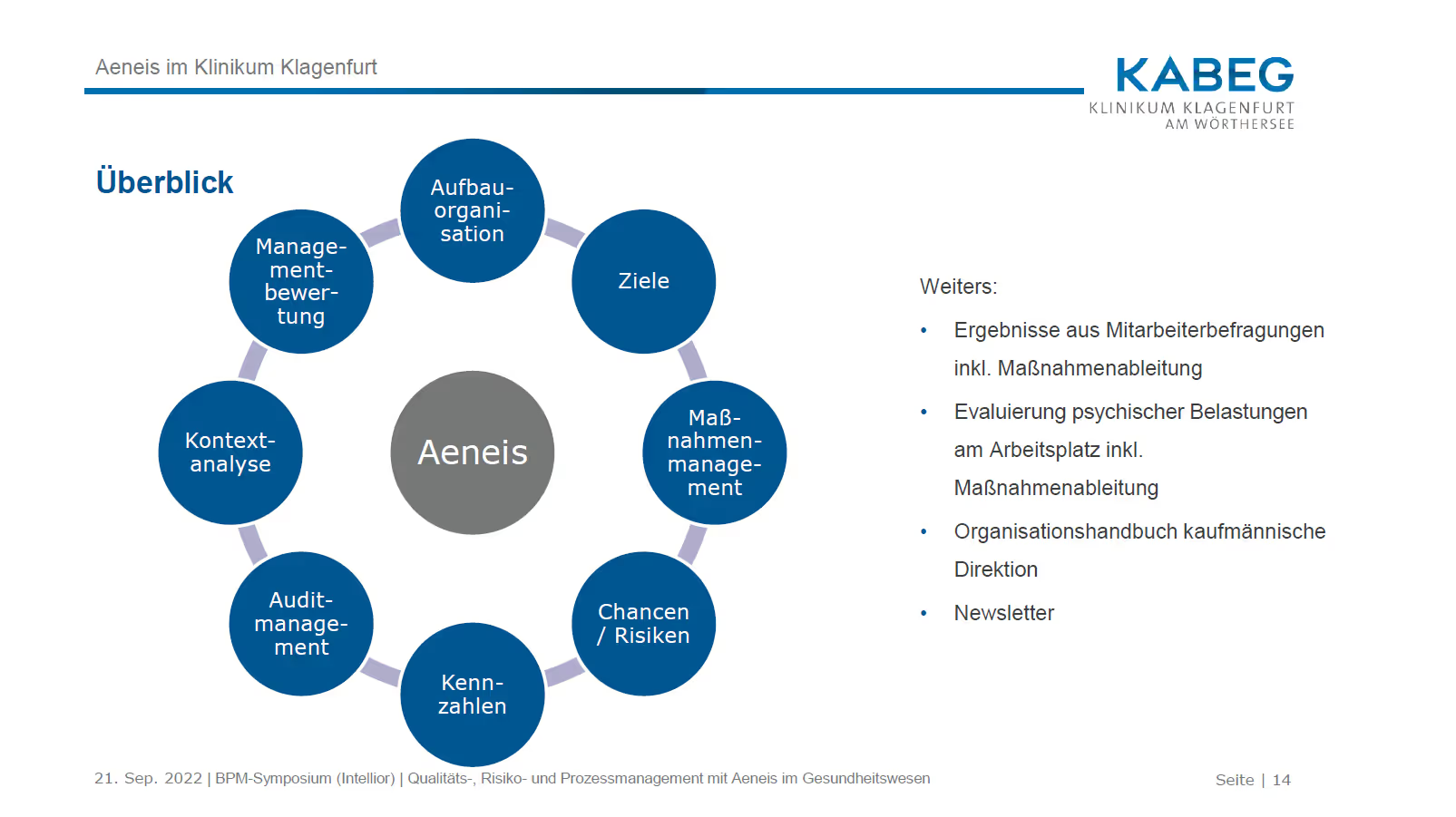
The staff unit continuously developed Aeneis. Over the years, the following functions have been integrated, among others:
- Organizational structure & department profiles
- Goal management including derivation chains
- Measure management with structured workflows
- Audit management (SmartEdit, findings, measures)
- Key figure management (quantitative & qualitative)
- Opportunity and risk management
- Context analysis (PESTEL)
- Integration of employee surveys and psychological stress assessment
- A 110-page automatically generated organization manual
- An internal newsletter straight from Aeneis
Everything in one system, without additional tools or parallel data storage.
Internal development instead of external dependency
With increasing use, Klinikum Klagenfurt wanted to tailor Aeneis even more specifically to its own requirements. Instead of relying on external services, the department decided to press ahead with the development itself.
“We have [...] started to conceptualize and plan really strategic things and then also address these further developments internally.” - Michael Baumann
As a result, adjustments could be implemented more quickly and feedback from the departments could be taken into account immediately. Over time, employees were even hired who specifically dedicated themselves to configuring Aeneis. In this way, the necessary know-how was permanently built up in-house, a clear advantage for remaining flexible and continuously developing Aeneis.
What Aeneis really did
The impact of Aeneis at Klinikum Klagenfurt was evident on several levels: organizationally, qualitatively, and in the daily work of employees. Many improvements are clearly measurable, others are particularly noticeable in everyday life, and it is precisely this combination that makes the success so clear.

One of the highest user quotas ever measured:
At Klinikum Klagenfurt, a daily utilization rate of around 10% of employees was measured. For a hospital of this size, this is unusual and shows how firmly Aeneis is anchored in everyday working life.
Less bureaucracy, more time for care:
Thanks to clear responsibilities, transparent chains of measures, and clear process structures, employees spend less time searching, inquiring or with Excel files. The time gained goes to where it is most important: to patients.
Higher quality through better interplay of information:
Audit findings, measures, risks, goals, and indicators are directly interlinked. The departments can immediately see what needs to be done and what has already been done.
Significant relief for managers:
Managers are also actively working with the system and benefit from the central database. Management reviews, reports, and evaluations can therefore be prepared much faster and more reliably.
Uniform standards across the network:
The three previously separate Aeneis instances are to be brought together to form a harmonized solution. A strong signal that Aeneids is a sustainable platform.
Aeneis is now the digital backbone of QM in hospitals
Over the years, Aeneis has developed into a central platform at Klinikum Klagenfurt, which brings together numerous quality-relevant tasks. Today, the software forms the basis of digital quality management and supports the company in managing processes, audits, risks, and measures in a structured and reliable manner.
--> More about Klinikum Klagenfurt's success story
An example of how process management can really relieve the load
Klinikum Klagenfurt impressively shows how software can be turned into a real working tool when it is correctly introduced, managed decentrally, and continuously developed.
Aeneids has created structure, increased transparency, combined processes, reduced duplication of work, and noticeably relieved the burden on departments. The result is more overview, more efficiency, and above all: more time for patients.
Experience how Aeneids can also simplify processes, create transparency and free up valuable time in your company. Book a personal live demo!

FAQs
Why do healthcare organizations rely on integrated process management?
Integrated process management with Aeneis creates transparency, reduces effort and makes it easier to manage quality, risk and compliance requirements, particularly in complex structures such as hospitals.
What role does decentralization play in process management?
When departments can maintain their content themselves in the Aeneis process management platform, acceptance increases significantly. Responsibilities are made clearer, information is more up-to-date and processes are managed closer to practice.
What are the benefits of developing Aeneis internally?
With in-house expertise, adjustments can be implemented more quickly and departmental requirements can be taken into account immediately.
How does Aeneis actually help to save time in everyday hospital life?
Aeneis combines central QM and RM information in one system, reduces search costs and creates clear responsibilities, thus allowing more time for actual core tasks.