How does “just modeling processes” become a productive, audit-proof intranet with active compliance and risk management? Using three practical use cases, PMS shows how Aeneis evolves from the process world to become a central IMS cockpit, including role management, acknowledgements, scopes, dashboards, and reports.
About PMS Elektro- & Automationstechnik
Founded in 2005 in St. Stefan, Austria, PMS Elektro & Automationstechnik (Electrical & Automation Engineering) has developed into a leading provider of electrical and automation technology. Today, the company has around 500 employees and is part of a steadily growing group of companies with several specialized subsidiaries.
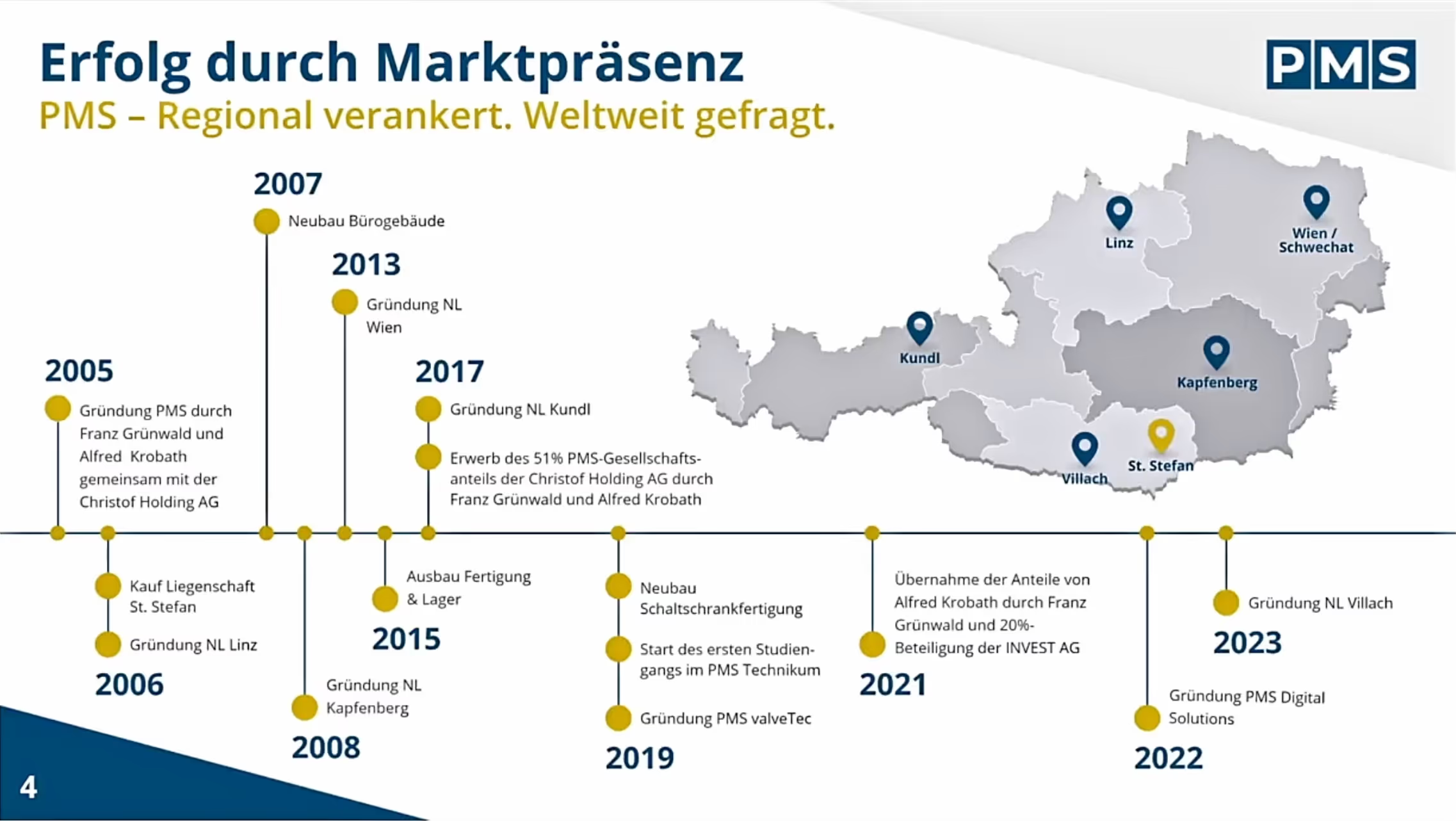
Note: Slide shows timeline of PMS:
- 2005: Founding of PMS by Franz Grünwald and Alfred Krobath together with Christof Holding AG
- 2006: Purchase of property in St. Stefan (Austria) and establishment of Linz branch (Austria)
- 2007: Construction of new office building
- 2008: Establishment of Kapfenberg branch (Austria)
- 2013: Establishment of Vienna branch
- 2015: Production & warehouse facilities
- 2017: Establishment of the Kundl branch (Austria) and acquisition of 51% of the shares in PMS by Franz Grünwald and Alfred Krobath from Christof Holding AG
- 2019: New switch cabinet production facility, launch of the first degree program at the PMS Technical Center, and founding of PMS valveTec
- 2021: Acquisition of Alfred Krobath's shares by Franz Grünwald and 20% stake by INVEST AG
- 2022: Founding of PMS Digital Solutions
- 2023: Establishment of Villach branch (Austria)
The PMS Group includes:
- PMS Elektro- & Automationstechnik: the parent company, specialized in the design, manufacture and installation of switchgear.
- PMS valveTec: expert for valve systems in hydraulic systems.
- PMS Digital Solutions GmbH: is driving digitization and Industry 4.0 forward, particularly in the area of paperless manufacturing.
- PSI Powerful Solutions: supports the Group's growth as a recruitment and service company.
This structure shows how broad and future-oriented PMS is. The company combines classic engineering with digital innovation and proves that quality craftsmanship and high-tech can go together perfectly.
The core competencies of PMS Elektro & Automationstechnik lie in the development and implementation of complex switching systems, from planning to construction and commissioning. This know-how is complemented by engineering, energy technology, industrial assembly and comprehensive service.
Through strong partnerships with leading technology companies such as Siemens Solutions and Rittal, PMS ensures that customers can always rely on the highest quality and cutting-edge technology.
From process model to active corporate management
Many organizations start with the Aeneis BPM software to document processes “first” and then remain in minimal mode due to audits or ISO certificates. The presentation by Lukas Grassler (PMS Group) impressively shows how things can be turned: At PMS, an earlier “process mapping tool” has become an intranet integrated into everyday life, with news, role profiles, tasks, IT assets, license management, hazardous substances register, action management and a cockpit for management & authorized signatories. In short: effective governance in day-to-day business.
In the following, we break down the most important findings into three reusable use cases that can be implemented with on-board tools from Aeneis and that meet the exact needs of modern GRC teams: active compliance and risk management, risk minimization & evidence, measures and knowledge management.
“Why do we use the Aeneis BPM tool and why is the Aeneis BPM software important to us? We need the Aeneis BPM tool in order to be able to somehow represent the ISO certificates of our companies and branches.” — Lukas Grassler, IT technician and process management expert at PMS Elektro- & Automationstechnik
Use case 1: Active compliance & risk management
Aeneis as a single point of information
With PMS, all important information is centrally located in the portal. Whether hardware, software licenses, roles, cost centers or certificates, everything is recorded in Aeneis and linked together. This creates a clear and reliable database that can be evaluated at any time.
Employees can find exactly the information they need without having to search for a long time. Roles and responsibilities are clearly defined and changes are automatically documented. If an object is changed, Aeneis informs the affected persons by email or directly in the portal. The notifications immediately take them to the right place to review tasks or issue approvals.

Note: Slide shows the personal dashboard of Lukas Grassler in Aeneis
This central information structure ensures that compliance and risk management work in day-to-day business. Those responsible maintain an overview at all times, evidence is comprehensible and all participants work with current, verified data. This makes Aeneis a real linchpin of corporate management.
Risk management from a single source
At PMS, risk management is closely linked to IT. All devices, licenses and certificates are recorded in the system and linked to employees, roles and cost centers. If a license expires or a certificate becomes invalid, Aeneis automatically recognizes this and informs IT technicians by email.
This avoids unnecessary costs and identifies risks at an early stage. Those responsible can see in tables which devices are active, which licenses are still valid and where action is needed. These automated evaluations help to make processes safe and efficient.
PMS is thus showing how technical risk management can be automated with Aeneis. Instead of maintaining Excel lists or waiting for reminders, the system itself ensures that they are up to date and transparent. In this way, IT remains audit-ready at all times and management has reliable evidence of all relevant systems.
IMS context in PMS
Aeneis was originally purchased by PMS to map processes for audits and ISO certifications. In the beginning, the system was only used when the auditor was at the door. It has now become an integral part of the integrated management system.
Today, Aeneis serves as a central corporate portal. Employees access it regularly to read news, retrieve work instructions or find information about internal processes. As a result, Aeneis has developed from a pure process mapping tool into a daily working tool.
“We have now redesigned this by saying that we are turning the PMS portal into our intranet so that employees check in more than once during the year.” — Lukas Grassler
Certifications such as ISO and EMAS also benefit from this. Documents and evidence remain up to date, audits are comprehensible and management can ensure that all information is maintained. PMS proves that a management system only works if it is used in everyday life and supported by all employees.
Use case 2: Risk minimization and evidence
Register of hazardous substances as a basis for safety
A central topic at PMS is the safe and comprehensible management of hazardous substances. For this purpose, a comprehensive register of hazardous substances has been set up in Aeneis, which contains all relevant information on the substances used. Each hazardous substance is recorded with manufacturer, intended use, water hazard class, H and P statements, protective measures and GHS label.
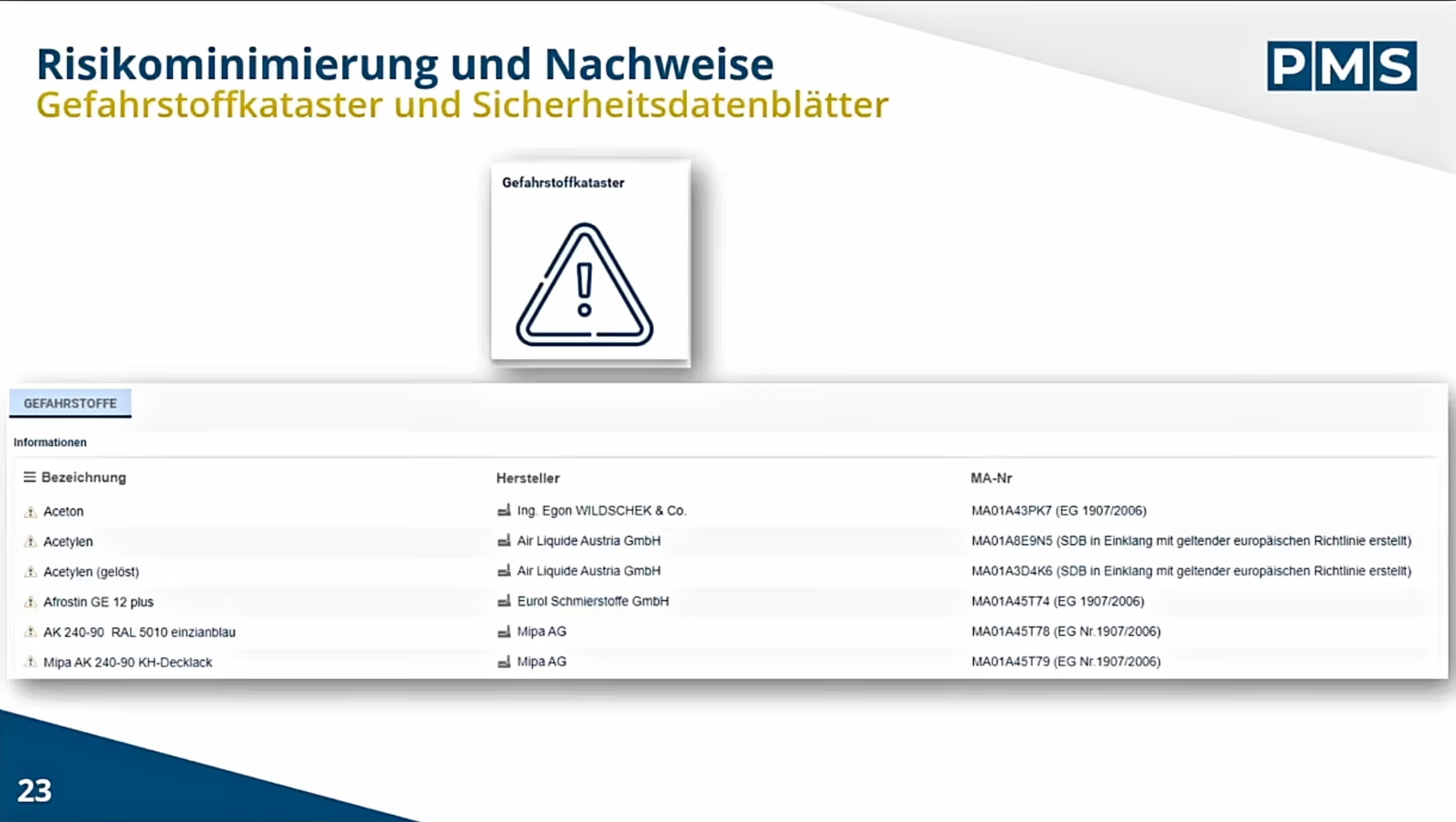
Each entry is also linked to the associated safety data sheet as a PDF. This allows fitters and employees on construction sites to access the latest data directly in the portal without having to search for it on the Internet. At the same time, management can ensure that all safety data sheets are regularly checked and up to date. This annual inspection is mandatory and is properly documented in Aeneis.
Evaluability through individual data sets
A major advantage of the system is that the data can be evaluated. With simple search queries, you can find specific substances that require specific protective measures. For example, a list of all hazardous substances for which hand protection is required can be created. The results are displayed directly in the portal and are immediately comprehensible.
The structure of the company is also reflected in the data. Employees and hazardous substances are assigned to the respective branches, which enables targeted evaluations per location. This makes it possible to see at any time which materials are used at which location.
Areas of application in preparation
In addition, PMS worked to define areas of application for documents and forms. The aim was for each subsidiary, such as PMS valveTec or PSI, to only see content that is relevant to them in the future. In this way, the flood of information is reduced and the overview in the portal is improved.
HSEQ folder as a central entry point
To make safety-related information even more accessible, a separate HSEQ folder has been set up on the homepage. Here, employees can find all important topics relating to the environment, quality, safety and health protection at a glance. From emergency plans to work instructions, all documents are centrally linked and clearly structured.
With this solution, PMS combines practical work safety with digital transparency. Aeneis helps to minimize risks, provide evidence and maintain an overview, both in the office and on the construction site.
Use case 3: Action and acknowledgement management
The PMS Cockpit as a control center
At PMS, the PMS Cockpit ensures that tasks and measures remain transparent and comprehensible for management and authorized signatories. Each responsible person sees in a clearly structured overview which tasks are assigned to them and what status they are in. Overdue tasks are highlighted in red, and completed tasks appear in a separate column.
With one click, a task can be opened, commented on or marked as completed. The progress is documented and is immediately visible to management. New tasks can also be created directly in the cockpit without using additional tools or tables. Administrators also have an overall view with filters and status displays to evaluate tasks by person responsible or categories.
When a new task is created, the person concerned automatically receives an email notification. As a result, no measure is ignored and everyone involved knows what is being worked on. PMS has set up a separate group for rights management, which determines who can create or edit tasks. As a result, the system is structured simply and securely at the same time.
Accounts as a binding transfer of information
Another important topic in the IMS of PMS is awareness. Changes to work instructions or processes must be actively confirmed by affected employees. It used to be difficult to get everyone up to date, but today the Aeneis portal does this job.
“It is of course difficult to inform employees when a work instruction or something else has changed. [...] that is why we introduced the action tool (acknowledgement function).” — Lukas Grassler
As soon as a new version of a document is released, all assigned employees receive an automatic notification. This email contains a direct link to the document in the portal. There, they can read the change and confirm with one click that they have read the information.
This confirmation is stored in the system and is comprehensible to supervisors. Division managers and administrators can check at any time who has already responded and who is still pending notification. On request, the list can also be printed out or used as proof for audits.

The concept ensures that all employees remain up to date with the same level of information and that changes within the company are clearly communicated. Aeneids thus turns information obligations into practice, clear, secure and verifiable.
Reliable communication within the management system
With the PMS cockpit and acknowledgement management, PMS has solved two central challenges: structured task management and secure transfer of information. Both functions ensure that measures are not only planned, but actually implemented, and that every change remains documented.
In this way, PMS combines operational action with verifiability and impressively shows how Aeneis makes the integrated management system a real tool for leadership, transparency and continuous improvement.
A real-life story in three acts and what organizations can learn from it
1. From process mapping tool to living portal
What at PMS once began as a pure tool for process modeling has developed into a company portal that is used daily. Employees regularly access Aeneis to find information, work instructions or the latest news. As a result, the system is no longer an audit assistant, but an active part of everyday work.
2. Compliance and communication that works
With clear roles, automated notifications and structured tasks, managers and employees always have an overview. Whether in the case of licenses, certificates or information, all information is up-to-date, comprehensible and transparently distributed. This is how a management system becomes a living communication platform.
3. Minimize risks through transparency and evidence
The hazardous substances register shows how safety and environmental requirements can be reflected directly in the system. All substances, safety data sheets and protective measures are stored centrally and can be evaluated. Management can thus prove at any time that legal requirements are being met and that all data is up to date.
PMS thus proves that process management, quality and safety only really work when they are linked together. Aeneis thus becomes a tool that dissolves information silos and creates transparency in all areas.
How PMS turned processes into practice with Aeneis
Lukas Grassler's presentation impressively shows what happens when a company uses a BPM tool not only for audits, but for everyday use. PMS turned former process documentation into a lively intranet that combines information, tasks, risks and evidence in one place.
Whether IT equipment, license management or a register of hazardous substances, everything is maintained transparently, up to date and comprehensibly. Management always sees where action is needed, and employees find the information they really need. This makes Aeneis a tool that strengthens safety, efficiency and collaboration in equal measure.
Anyone who uses an integrated, digital management system today needs exactly this combination of structure, transparency and suitability for everyday use, and that is exactly what Aeneis does.

FAQs
What is an integrated management system (IMS)?
An integrated management system (IMS) combines various management approaches such as quality, environment, occupational safety, energy or information security in a common structure. This avoids duplication of work and makes use of synergies. With Aeneis, these systems can be digitally combined, documented and evaluated, as in the PMS example, where processes, risks and evidence are managed centrally.
How does BPM software like Aeneis support risk management?
BPM software structures processes and shows responsibilities transparently. Risks can thus be anchored where they arise: in the process itself.
Aeneis enables the digital recording, evaluation and monitoring of risks as well as the allocation of measures and responsible persons. This gives companies a central, auditable basis for their risk management.
Why is a digital register of hazardous substances useful?
A digital register of hazardous substances ensures that all safety-relevant information is up-to-date and accessible at all times. Employees can immediately identify which protective measures apply and which substances have been tested.
With Aeneis, hazardous substance data can be displayed in a structured manner, safety data sheets stored and regular tests documented, just as PMS has successfully implemented.
What are the benefits of centralized task and acknowledgement management?
When tasks, measures and information are managed centrally, transparency is created about the processing status and responsibilities.
Aeneis offers integrated workflows, notifications, and verification functions for this purpose. As a result, managers and employees always have an overview.
How can Aeneis be introduced in companies?
The introduction of Aeneis is carried out gradually: Processes and organizational structure are typically modeled, and modules for risk or audit management can then be integrated.
Many companies, such as PMS, start with process documentation and then further develop Aeneis into a central management portal. The result is a sustainable, practical implementation that employees really use.