Two worlds, one destination
When two companies with different management systems are brought together, there is bound to be friction: different tools, duplicate processes, media breaks and high manual effort. This was exactly the challenge faced by ATLAS ELEKTRONIK GmbH, embedded in the ThyssenKrupp Group's Marine Systems business unit.
The vision was clear: A central system, a “one process” that applies to everyone and creates trust.
The claim: fast, pragmatic and with broad acceptance.
And that was exactly achieved: In just six months, ATLAS ELEKTRONIK migrated its management systems to the Aeneis BPM suite, creating the basis for a lively, continuously growing integrated management system (IMS).

The starting point: tool growth and head integration
Before the project, the situation was typical for many large organizations:
- Different tools at ATLAS ELEKTRONIK and thyssenkrupp Marine Systems.
- No uniform platform for processes, instructions, audits and key figures.
- Information integration took place “in the head” of those responsible, which required an enormous amount of manual effort.
“None of the tools spoke to each other, the integration took place in our heads and we wanted to resolve that. ”
— Topi Tervo, Aeneis Introduction Project Manager, ATLAS ELEKTRONIK
The problem wasn't just technical. For around 3,500 to 4,000 active users, the situation meant:
- long search times for the right documents
- double work because similar content was maintained multiple times
- high risk of errors during audits, as connections had to be established manually rather than systemically
The vision: A single point of truth. Every employee should have only one answer to the question “Where can I find the process I work according to?“: “One Process.”

The journey: Six months full speed
1. Pragmatism before perfection
ATLAS deliberately decided against long concept phases. Instead: Migrate the status quo in order to be usable as quickly as possible.
- Content from old systems was transferred
- Histories were saved, but not unnecessarily inflated
- Features that could be overwhelming (such as reviews) were initially deactivated
This created a stable base in record time.
“We didn't want to question everything, we wanted to bring everything into the new system first so that we could start quickly and then develop further. ”
— Topi Tervo
2. Agile customizing
The team focused on parallelism instead of waterfall: While processes were migrated, administrators continuously adapted the portal and structures in Aeneis.
Example: Initially, only the most necessary schema was implemented so that the modelers could start. At the same time, the portal was visually and functionally refined. This agile approach was the key to meeting the tight schedule.
“If we had taken a classic approach, we would never have done it in six months. ”
— Topi Tervo
3. Change & communication: From all directions
The rollout was not a silent go-live, but an orchestrated change process. ATLAS relied on communication that could not be overlooked:
- Posters: At the site alone with 1,600 employees, over 100 posters were distributed.
- Flyers on every desk so that really every person was reached.
- Teaser on the intranet to spark curiosity.
- Key users (managers, process owners) were intensively trained even before the rollout.
In addition, 2-3 target group-specific training sessions per week were held in the first few months after go-live, which proved particularly effective.
- Modelers were not only trained in how to use the software, but also empowered as process designers to think critically.
- Editors learned to enrich processes with texts, roles and links.
- End users received practical introductions so that they could work productively from day one.
One deliberate lever was the development freeze after go-live: The system remained stable for three months, without ongoing changes. This gave employees time to adapt without being unsettled by constant adjustments.
4. Involvement of all employees
ATLAS was transparent about the fact that the system was not yet perfect when it went live. Instead, it invited everyone to get involved.
- Over the course of two years, around 700 improvement suggestions were submitted via the CIP module in Aeneis, of which over 450 were implemented.
- Examples: Adding a missing role link, linking a document more clearly, but also major process adjustments.
- Employees experienced: “My idea has an impact. ”
“We wanted to show that the system is alive and everyone can contribute to it. ”
— Topi Tervo
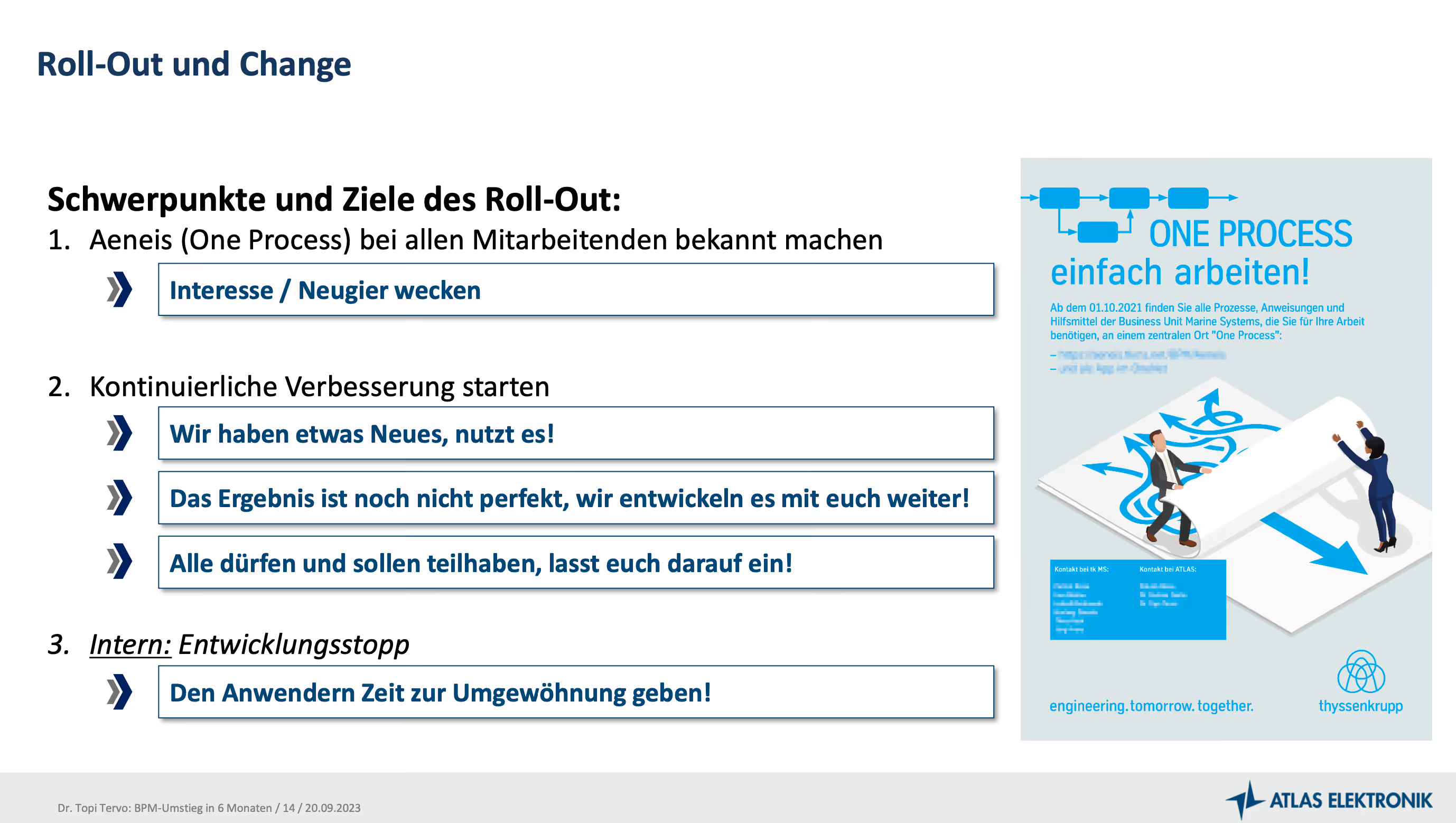
Note: The slide contains the key areas and objectives of the rollout:
- Make Aeneis (One Process) known to all employees:
Spark interest/curiosity - Start continuous improvement:
We habe something new, use it!
The result is not yet perfect, we will continue to develop it with you!
Everyone can and should participate, get involved! - Internal: Development freeze:
Give users time to get used to the change!
The results: A system that connects and lives
A central point of contact for everyone
With the go-live, “One Process” became a permanent point of contact for several thousand employees. Instructions, process models and audit plans are no longer in various tools, but in a platform that is directly accessible via the intranet.
This eliminated the tedious search for the “right version” or for scattered information. Today, anyone who needs something will find it in One Process.
“No matter who we ask, everyone must be able to say right away: 'One Process.' That is our claim. ”
— Topi Tervo
Consistent and understandable process models
By switching to BPMN 2.0, ATLAS was able to significantly improve the quality of process representations. Where different notations and styles existed side by side before, there is now a consistent overall picture. This not only makes it easier for employees to understand, but also creates trust among auditors and certifiers.
More efficiency in day-to-day business
Relieving the workload on specialist departments is a major success. Processes, roles, documents and standard requirements are now systematically linked together.
- In the past, auditors and quality managers had to spend hours collecting information.
- Today, they can prove where a standard requirement has been implemented in the company at the push of a button.
- Managers also benefit from greater transparency and improved evaluation options.
The result: time savings, less duplication of work and more freedom to focus on improving content.
More easy planning and execution of audits
With the Audit module in Aeneid, ATLAS can centrally plan the audit program and document results. All parties involved have access to the same data, and evidence can be linked directly to processes and documents. This makes audits more predictable, efficient and, above all, less stressful.
CIP culture as an engine of development
The high level of employee participation is a particularly strong signal:
- In two years, over 700 suggestions for improvement were submitted.
- More than 450 of them have already been implemented, ranging from small optimizations to major process changes.
These figures show that the management system is not a static set of rules, but is actively lived and developed by employees. The direct return channel via the CIP module ensures that ideas are taken seriously and visibly implemented.
Broad acceptance through involvement of all user groups
The fact that over 5,000 end users are working productively with Aeneis today is the result of a clear strategy: ATLAS has addressed all target groups differently, from modelers to editors to end users.
- As process designers, modelers were empowered to actively shape quality.
- Editors supplement processes with texts and role links.
- End users were quickly brought on board through intensive training and clear communication.
As a result, “One Process” has become not just an IT system, but part of daily work reality.
A sustainable basis for the future
Even though the start was deliberately chosen pragmatically, today it is clear that the platform is constantly growing with requirements.
- More and more data is being linked together.
- Other management systems are gradually following suit.
- New evaluations and reports are being developed to present key figures more transparently.
This has created a stable yet flexible basis that supports the integrated management system over the long term.
Success factors: What other organizations can learn
- A clear vision: Aeneis was not introduced in isolation, but was part of an IMS strategy.
- Speed: Migrate the status quo quickly instead of waiting for the “perfect” start.
- Agility: Do customizing and migration in parallel.
- Communication: Think big rollout with posters, flyers, intranet, key users.
- Stability: After go-live, a conscious break to make it easier to get used to.
- Participation: Take CIP culture seriously, involve employees.
- Continuity: Project manager assumed line responsibility — no disruption, only growth.
- Technical leverage: Features such as audit and CIP modules or flexible portal design increase acceptance and utilize synergies.

Note: The slide contains the key success factors:
- The project framework conditions were right: Vision for the IMS and milestones to achieve the vision. Aeneis introduction as part of a coordinated process.
- Implementation as a structured project: with realistic goals and milestones, allowing freedom for the core project team
- Focus on speed: Agile response to project development. Don't look for perfect solutions: A management system thrives on improvement.
- Focus on change: Specific training for the various user groups. Intensive support for all project staff “Communication and training campaign”
Conclusion: Working together towards an integrated management system
The introduction to ATLAS ELEKTRONIK impressively shows that even large organizations with many participants can focus on a joint management system in a short period of time if the target image, project structure and change management are right.
The courage to start pragmatically, pick up speed and involve employees right from the start was decisive. With the Aeneis BPM suite, a platform was available for this that offers stability and at the same time can be flexibly developed.
Today, several thousand employees work with a central “One Process” portal and are continuously developing it. The result is a management system that not only documents processes, but is actively lived by people in the company.
Would you like to find out what such a procedure could also look like in your organization? Schedule a live demo or test Aeneid and discover how you can further develop your management system step by step.

Frequently asked questions (FAQ)
How does a migration to the Aeneis BPM suite typically work?
The migration takes place in several steps: selection and customization of the platform, transfer of relevant legacy data, parallel adaptation of portals and structures, and accompanying change management with communication and training. Depending on the initial situation, implementation can be completed in just six months, as was the case with ATLAS ELEKTRONIK.
What are the biggest benefits of a “single point of truth” in process management?
A central system reduces media breaks, avoids duplication of work and creates transparency. Employees can reliably find processes, instructions and audit information in one place without lengthy searches or coordination efforts.
How does Aeneis assist with audits and certifications?
With the audit module, audit programs can be planned and documented and evidence can be linked directly to processes and documents. In this way, auditors can receive targeted answers, for example to standard requirements, and the organization saves valuable time.
How are employees involved in the development of the management system?
With the integrated CIP module, employees can contribute feedback, ideas and suggestions for improvement directly into the system. These are evaluated, prioritized and, if appropriate, implemented. This promotes acceptance and ensures that the management system remains alive.
Which organizations is Aeneis particularly suitable for?
Aeneis is ideal for companies with complex structures, multiple locations or high regulatory requirements, for example in finance, in the energy sector, in healthcare, at KRITIS or in mechanical engineering. Thanks to its flexibility, it can be individually adapted to existing IT landscapes.